
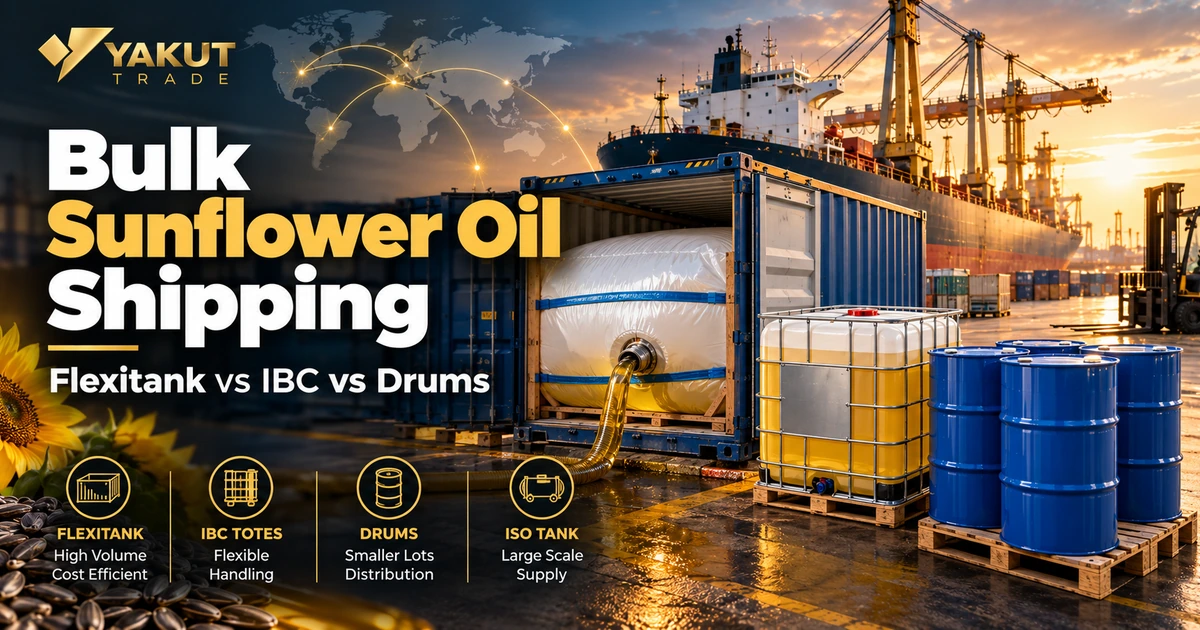
Bulk Sunflower Oil Shipping: Flexitank vs IBC vs Drums
Choosing the right shipping method for bulk sunflower oil can make a significant difference to landed cost, cargo safety, unloading efficiency and operational flexibility. This guide compares flexitanks, IBC totes, drums and tank-based transport to help international buyers select the most suitable option.
This article explains how to compare these alternatives commercially and technically before issuing a Request for Quotation (RFQ).
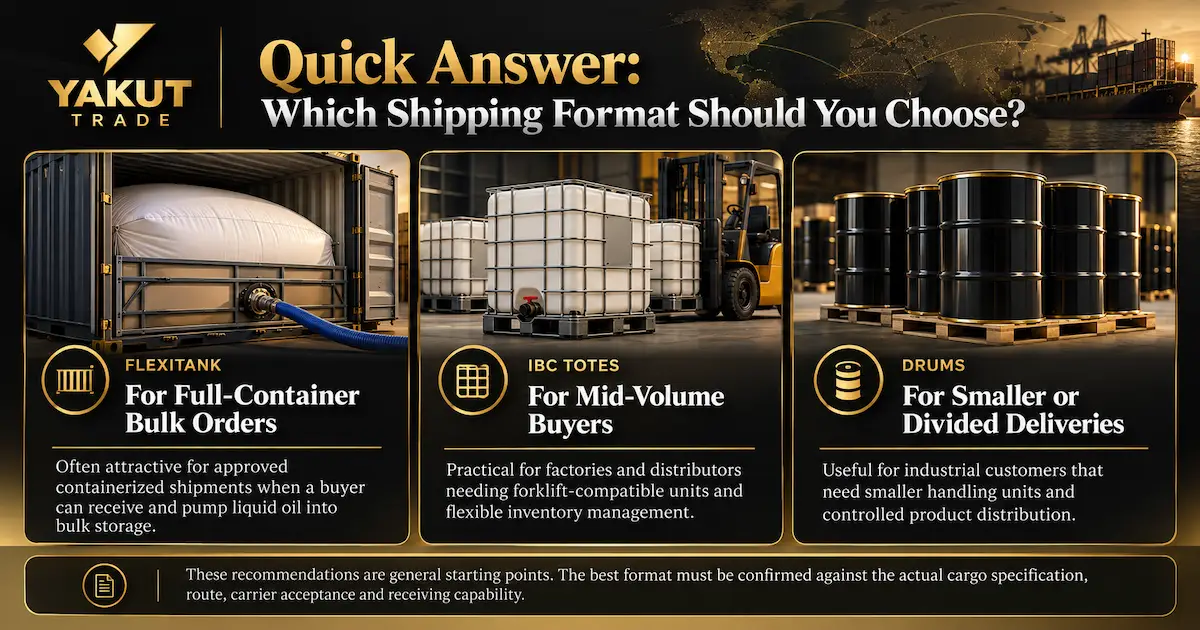
Flexitank vs IBC vs Drums vs ISO Tank: Shipping Comparison
The following table summarizes the main commercial differences between common liquid-oil transport formats.
| Factor | Flexitank | IBC Tote | Drums | ISO Tank |
|---|---|---|---|---|
| Typical Unit | Single-use liquid liner in a container | Rigid portable tank | Individual sealed drums | Reusable tank container |
| Indicative Capacity | Up to about 24,000 L in qualifying systems | Often 1,000 L | Often around 200 L | Varies; commonly about 20,000–26,000 L |
| Handling | Pump discharge | Forklift and controlled liquid transfer | Drum handling and dispensing | Pump discharge |
| Receiving Requirement | Compatible pumping and storage | Forklift and suitable transfer equipment | Drum unloading and dispensing | Tank-compatible discharge setup |
| Main Advantage | Fewer individual packages | Flexible handling and inventory | Small-unit distribution | Reusable tank system |
| Main Challenge | Leakage risk and destination unloading | Unit cost and space usage | More handling and packaging | Availability, cleaning and return logistics |
Capacity figures are indicative, not contractual shipment limits. Actual fill volume and weight must comply with the tank or packaging design, oil density, container payload, carrier approval and route restrictions.
What Is Flexitank Shipping for Sunflower Oil?
A flexitank is a flexible liquid-containment system installed inside a suitable freight container. It allows compatible, non-dangerous liquid cargo to be transported without filling individual drums or IBCs.
A typical export configuration uses an approved flexitank system inside a 20-foot general-purpose container. The installation includes a liner, fittings, valve arrangements, restraints and container preparation.
According to Container Owners Association guidance, qualifying systems are designed for maximum capacities of up to approximately 24,000 litres and 24,000 kilograms, but the permissible actual load may be substantially lower depending on the carrier and route.
Advantages of Sunflower Oil Flexitank Shipping
- Moves a large liquid volume within one container.
- Eliminates the need for numerous individual drums or totes.
- Can reduce packaging and handling costs at appropriate order volumes.
- Supports direct transfer into suitable receiving tanks.
- May work well for recurring full-container food-industry imports.
- Uses established container shipping networks where the carrier accepts the system.
Limitations and Risks of Flexitanks
Flexitanks must be treated as specialized shipping systems rather than ordinary bags placed inside containers.
A damaged liner, inappropriate fitting, poor installation or unsuitable container can create a significant leakage incident. Loading and unloading also require suitable equipment and trained operators.
Before choosing a flexitank, buyers should verify the manufacturer’s system qualification, installation procedures, container condition, product compatibility and ocean carrier acceptance.
Destination facilities must also be able to discharge the oil efficiently. A buyer without suitable pumps, hoses, trained personnel or storage capacity may face avoidable delays.
Flexitank Loading: Five Critical Controls
01
Container Inspection
Check floor, walls, doors, sharp surfaces and structural condition.
02
System Approval
Confirm flexitank compatibility, qualification and carrier acceptance.
03
Food-Contact Safety
Use suitable clean food-contact materials, valves and hoses.
04
Fill Control
Meet approved fill limits and verified gross-mass requirements.
05
Sealing & Records
Record seals, loading quantity and cargo condition.
Reference: Container Owners Association Flexitank Code of Practice and associated carrier requirements.
Sunflower Oil in IBC Totes: When Does It Make Sense?
An Intermediate Bulk Container (IBC) is a rigid portable container designed to transport and store liquids. A common industrial configuration holds around 1,000 litres and can be moved using suitable forklift equipment.
For sunflower oil buyers, IBC totes provide an intermediate option between individual drums and full-container bulk liquid shipments.
They are particularly relevant for companies that consume meaningful amounts of oil but do not require an entire flexitank per delivery.
Advantages of IBC Sunflower Oil Shipping
- Convenient for warehouse and factory deliveries.
- Suitable for partial consumption and staged production.
- Can be moved with compatible forklifts.
- Allows multiple product types or batches to be kept separate.
- Useful for factories without large bulk storage tanks.
- Supports controlled dispensing into production equipment.
IBC Limitations
IBC totes occupy packaging space, and the combination of container structure, pallet base and individual handling can increase cost compared with a well-utilized full-container flexitank shipment.
Buyers must also consider whether the IBC is single-use or reusable, who owns it, whether cleaning is required and how empty units are managed.
For edible oil, the liner or container body, outlet valve and other product-contact surfaces must be suitable for the intended food application.
Buyer Recommendation
Choose IBCs when flexible inventory control and simpler site handling provide more value than achieving the lowest possible packaging cost per metric ton.
Shipping Sunflower Oil in Drums
Drum packaging remains relevant for industrial and wholesale buyers requiring smaller individual units.
Drums are available in different materials and sizes. A commonly encountered commercial format is around 200 litres, although the exact net capacity, product-contact suitability and permitted filling weight depend on the drum design.
Why Some Buyers Prefer Drums
Drums can be practical for buyers receiving modest volumes, serving multiple distribution points or using oil in smaller production batches.
They may also offer greater flexibility when the receiving site does not have an integrated bulk-liquid storage and pumping system.
Disadvantages of Drum Shipping
More Packaging
A larger number of individual containers increases packaging material and handling requirements.
Additional Labour
Drums must be moved, stored, opened, dispensed and managed after emptying.
Higher Handling Cost
Many smaller handling units can increase the cost of unloading and warehouse management.
For buyers purchasing full-container quantities regularly, the packaging and handling cost of drums may outweigh their flexibility. A comparative freight quotation is necessary before deciding.
What About ISO Tank Containers and Bulk Liquid Vessels?
Although the main purchasing decision often involves flexitanks, IBCs and drums, two additional formats should be considered for more demanding supply programs.
Food-Grade ISO Tank
A reusable tank container may suit repeat shipments between locations equipped for tank-container handling and liquid discharge.
The tank specification, previous cargoes, cleaning history, seals, fittings and food-contact suitability must be checked.
Commercial costs may also include tank leasing, cleaning and repositioning after discharge.
Dedicated Bulk Liquid Vessel
For substantial industrial quantities, specialized bulk liquid vessels may support larger shipment programs.
Such shipments require suitable loading terminals, receiving tanks, pipelines or hoses, pumping infrastructure and cargo-tank controls.
The receiving port must be technically prepared before the vessel is nominated.
Sunflower Oil Shipping Cost: Which Format Is Cheaper?
There is no universally cheapest shipping format. Freight economics depend on route, order volume, equipment availability, packaging costs, port conditions and receiving infrastructure.
For a full-container transaction with suitable loading and unloading arrangements, flexitanks may reduce the number of individual packages and support an attractive delivered cost.
However, IBCs or drums can be more economical for smaller or fragmented requirements when the alternative is paying for unused container capacity or investing in bulk-discharge equipment.
ISO tank costs can also be attractive in certain repeat programs, but availability, cleaning, leasing and empty repositioning may change the result.
Calculate Total Landed Cost per MT
A useful comparison should include the full cost of the proposed shipping configuration.
Include only costs not already covered in the supplier quotation. This avoids counting the same freight or packaging charge twice.
Costs Buyers Often Forget
- Flexitank installation and liner cost.
- Food-grade hoses and pump rental.
- IBC or drum handling charges.
- Warehouse storage and labour.
- Empty IBC return or disposal.
- ISO tank cleaning and repositioning.
- Destination detention and demurrage.
- Cargo residue, leakage and operational losses.
- Import clearance, duties and inland delivery.
Best Shipping Method by Buyer Type
Different buyer profiles have different priorities. An importer supplying one food factory may make a different choice from a regional distributor serving dozens of customers.
| Buyer Situation | Likely Option | Main Reason |
|---|---|---|
| Food Factory Receiving Full Containers | Flexitank | Bulk delivery with fewer individual packages. |
| Mid-Sized Food Manufacturer | IBC | Flexible storage and gradual consumption. |
| Small Wholesale Distributor | Drums / IBC | Smaller lots and multiple delivery points. |
| Large Edible-Oil Refiner | Bulk Vessel / ISO Tank | Large-scale processing with dedicated infrastructure. |
| Repeat Intermodal Supply Program | ISO Tank / Flexitank | Depends on route, cleaning, equipment availability and contract volume. |
| Company Without Bulk Storage | IBC / Drums | Avoids the need for a permanent bulk tank installation. |
Food-Grade Safety: Why the Shipping System Matters
Sunflower oil may be an edible food product, but its quality can deteriorate during storage and transport if handling conditions are unsuitable.
Important risks include oxidation, contamination and contact with moisture or unsuitable materials. Proper packaging and tank preparation are therefore essential.
Oxidation
Excessive contact with oxygen, elevated temperatures and certain metals can accelerate oxidation. Buyers should minimize unnecessary air exposure and follow appropriate storage and handling practices.
Moisture and Hydrolysis
Water ingress or insufficiently dry transfer systems can create quality problems. Tanks and product-contact equipment should be clean and dry before loading.
Previous Cargo Contamination
For reusable transport tanks and bulk vessels, previous cargo history is particularly important. Residues may remain in coatings, pipelines, pumps and fittings even when the tank appears clean.
Important for Edible Oil Buyers
Confirm food-contact suitability, cleaning records and applicable previous-cargo restrictions before using reusable tanks or bulk vessels. Requirements can differ depending on whether the oil is crude and intended for refining or refined and intended for further food manufacturing or distribution.
The Codex Code of Practice for the Storage and Transport of Edible Fats and Oils in Bulk and relevant FOSFA guidance provide an established framework for these checks.
Pre-Shipment Inspection and Quality Control
A professional shipment should have clearly defined quality and quantity acceptance procedures.
Independent inspection may be appropriate for larger transactions, unfamiliar supply chains or shipments where the buyer requires additional confidence in cargo condition.
Pre-Shipment Checklist
For a detailed explanation of crude and refined oil quality differences, see our article Crude vs Refined Sunflower Oil: Which Should Bulk Buyers Choose?
Unloading Requirements at the Destination
The destination facility should be evaluated before the shipping format is chosen, not after the cargo has arrived.
Receiving a Flexitank
The receiving site normally needs a suitable discharge pump, approved food-contact hoses, available storage capacity, trained personnel and a clear procedure for handling residual oil and the used liner.
Receiving IBC Totes
IBCs usually require forklift-compatible unloading and a suitable location for storage and dispensing. Individual units should be checked for leaks, damage and correct labeling.
Receiving Drums
Drums require appropriate handling equipment, storage space and controlled dispensing. Workers should avoid damaging the drums during movement and opening.
Receiving ISO Tanks
ISO tank deliveries require compatible transfer fittings, pumping arrangements and an agreed process for empty tank return, cleaning or repositioning.
Avoid Destination Delays
Confirm the unloading rate, receiving hours, storage capacity, equipment availability and expected empty-container or tank return timeline before the shipping booking is finalized.
FOB, CFR, CIF and FCA: Comparing Shipping Offers
Incoterms define important delivery, cost and risk responsibilities. The correct Incoterm should match the actual shipment structure.
| Term | General Meaning | Typical Buyer Consideration |
|---|---|---|
| FOB | Seller delivers on board the nominated vessel at the loading port. | Main freight, insurance and destination arrangements. |
| CFR | Seller pays freight to the named destination port; transport risk transfers on board at origin. | Insurance and destination charges. |
| CIF | Seller pays freight and contractually required insurance to the destination port; risk transfers on board at origin. | Insurance scope, unloading and import charges. |
| FCA | Seller delivers to the buyer’s carrier at the agreed named place. | Often appropriate for containerized or multimodal shipments. |
FOB, CFR and CIF are maritime rules and may be appropriate for traditional bulk-vessel commodity transactions. For containerized flexitank, IBC or drum shipments, buyers should also evaluate FCA, CPT or CIP according to the transaction.
Importantly, CIF does not mean that all risks remain with the seller until the cargo reaches the destination. Buyers should verify cargo insurance and the actual point of risk transfer under the agreed Incoterms 2020 rule.
Cargo Insurance and Flexitank Leakage Risk
Cargo insurance is an important consideration for liquid commodity shipments. Buyers should not assume that every standard marine policy automatically covers every type of flexitank leakage, contamination or handling incident.
Before the shipment, review the insurance conditions with the insurer or broker and clarify the relevant insured risks, exclusions, deductibles and claims documentation.
For flexitank transport, the insurer may require evidence of approved equipment, proper loading, carrier acceptance and adherence to recognized operational procedures.
Buyers should also define how cargo loss, contamination, quantity shortage and damage will be documented and investigated.
Shipping Documents for Bulk Sunflower Oil
A successful international shipment should be supported by a consistent document set. The exact requirements depend on origin, destination, Incoterm, payment structure and product specification.
| Document | Purpose |
|---|---|
| Commercial Invoice | Identifies seller, buyer, goods, quantity, price and commercial terms. |
| Packing / Weight List | Documents packed units or bulk quantity and weight basis. |
| Certificate of Analysis | Provides relevant laboratory test results for the identified oil. |
| Certificate of Origin | Supports documented product origin where required. |
| Bill of Lading / Transport Document | Records carriage and shipment information. |
| Inspection Certificate | Records findings within the agreed inspection scope, if required. |
| Insurance Certificate | Documents agreed insurance cover where applicable. |
| Cleaning / Suitability Records | Support food-contact suitability where required for reusable tanks or bulk vessels. |
Additional food-safety or regulatory certificates may be necessary depending on destination rules. Buyers should also confirm that shipment identity, quantity, seals and relevant batch information remain consistent across documents.
Common Mistakes When Shipping Sunflower Oil Internationally
Comparing Freight Alone
Ignoring packaging, unloading, storage and container return costs.
Selecting the Wrong Format
Choosing flexitanks without appropriate receiving and pumping infrastructure.
Insufficient Quality Checks
Failing to inspect food-contact surfaces, COA or sampling procedures.
Ignoring Carrier Restrictions
Assuming maximum flexitank capacity is permitted on every route.
Unclear Insurance
Not checking coverage for leakage, contamination and cargo loss.
Poor Destination Planning
Underestimating discharge time, storage limits and detention charges.
How to Choose the Right Shipping Format in 5 Steps
01
Define Order Volume
Trial, container load or recurring bulk program?
02
Check Product Type
Crude, refined, RBDW or high-oleic oil.
03
Review Receiving Site
Pumps, forklifts, tanks and unloading capacity.
04
Compare Total Cost
Freight, packing, insurance and destination expenses.
05
Verify the Plan
Supplier, inspection, carrier and documents.
How Yakut Trade Supports Bulk Sunflower Oil Buyers
Yakut Trade supports international buyers sourcing agricultural commodities by reviewing technical and commercial requirements and coordinating relevant trade processes.
For bulk sunflower oil, the right sourcing approach begins with understanding product type, specification, order volume, destination and handling capability before evaluating shipment options.
01
Buyer Requirement
Product type, volume, destination and shipping preference.
02
Supply Assessment
Review relevant sourcing opportunities and available configurations.
03
Commercial Review
Review specifications, documents, packing and delivery terms.
04
Transaction Support
Support agreed commercial communication and shipment coordination.
Learn more about our commodity sourcing and international trade services or explore supplier verification services for additional counterparty assessment.
Bulk Sunflower Oil Shipping RFQ Checklist
Providing complete information helps suppliers and trading partners evaluate realistic freight, packaging and availability options.
Frequently Asked Questions About Bulk Sunflower Oil Shipping
Conclusion: Choose the Shipping Method That Fits Your Business
Flexitanks, IBCs, drums and reusable tanks all have a role in international sunflower oil trade. The best option depends on how the buyer receives, stores, processes and distributes the oil.
For a factory receiving recurring full-container volumes, a properly approved flexitank system may be commercially attractive. For buyers with moderate demand or limited storage infrastructure, IBCs may provide better handling flexibility. Drums remain useful for smaller lots and distribution across multiple sites.
For larger or specialized supply programs, ISO tanks and bulk liquid vessels may deserve consideration.
Whatever format is selected, final procurement decisions should account for cargo quality, food-contact safety, unloading readiness, commercial terms and total delivered cost. An appropriate shipping arrangement protects both product value and operational continuity.
Need Sunflower Oil in Flexitanks, IBCs or Drums?
Share your required oil type, quality specification, quantity, destination and preferred shipping format. Yakut Trade can review suitable sourcing opportunities, packaging options and current commercial terms.
Availability, shipment configuration and quotation terms depend on product specifications, actual volume, route and prevailing commercial conditions.
Technical References
Container Owners Association — Flexitanks | TT Club — Flexitank Safety | Codex — Edible Oil Storage and Transport | FOSFA — Carriage of Oils and Fats | ICC — FCA vs FOB