
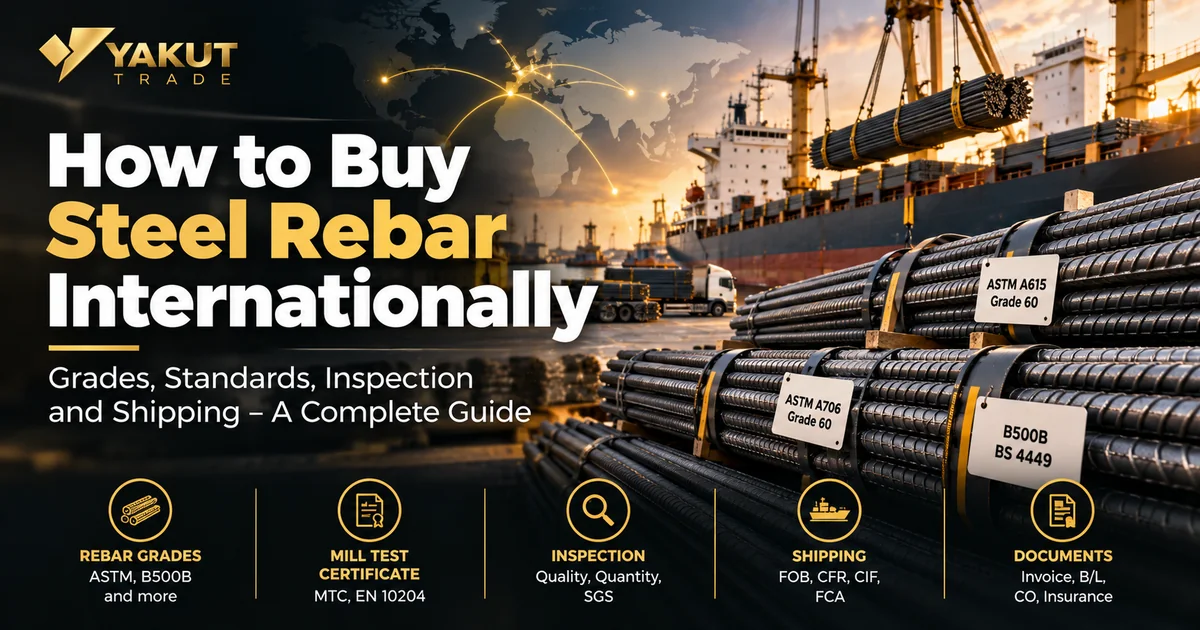
A quotation for ASTM A615 Grade 60, for example, should not automatically be considered equivalent to an offer for B500B reinforcement steel. Even when products serve similar construction applications, their standards, yield strength, ductility, identification requirements and acceptance criteria may differ.
This international steel rebar buying guide explains how to select the correct grade, evaluate mill certificates, calculate order quantities, arrange independent inspection, compare shipping terms and reduce commercial risks when importing reinforcing steel.
How to Buy Steel Rebar Internationally: Grades, Standards, Inspection & Shipping
A practical B2B guide for buyers importing reinforcement steel for construction, infrastructure and industrial projects.
Steel Rebar Buying Guide: The Essential Procurement Checks
Before accepting a steel rebar offer, an international buyer should establish six basic requirements. Each requirement influences the technical suitability, total cost and commercial reliability of the shipment.
01. Steel Standard
ASTM, BS or another project-approved specification.
02. Rebar Grade
Required strength, ductility and weldability.
03. Dimensions
Nominal diameter, length and weight tolerance.
04. Mill Documentation
MTC, heat number and test results.
05. Inspection
Quality, quantity, marking and loading verification.
06. Delivery Terms
Incoterm, shipping method, destination and payment.
What Is Steel Rebar and Who Buys It Internationally?
Steel reinforcing bar, commonly called rebar, is used to reinforce concrete structures. Concrete performs well under compression, while reinforcement steel provides tensile resistance and helps structural members respond to design loads.
International demand comes from a wide range of buyers, including general contractors, infrastructure developers, precast concrete manufacturers, construction-material distributors and public-sector procurement programs.
Common applications include residential buildings, commercial structures, bridges, foundations, tunnels, industrial facilities and transportation infrastructure.
For international sourcing opportunities covering reinforcement bars and other industrial metals, review Yakut Trade’s steel, rebar and aluminium supply portfolio.
1. Understand International Steel Rebar Grades and Standards
The correct standard should be established before requesting quotations. A supplier may offer reinforcement steel produced under ASTM, British or other national specifications, but the buyer must confirm that the material is acceptable for the intended construction project.
ASTM A615: Carbon-Steel Reinforcement
ASTM A615/A615M covers deformed and plain carbon-steel bars for concrete reinforcement. A commonly traded designation is Grade 60, which corresponds to a specified minimum yield strength of approximately 420 MPa in the SI designation.
Buyers should verify the actual ASTM edition required by their project and confirm the applicable mechanical tests, bar sizes and marking requirements.
ASTM A706: Low-Alloy Reinforcement With Controlled Properties
ASTM A706/A706M covers low-alloy reinforcing bars with controlled chemical and mechanical properties intended to support applications requiring particular ductility or enhanced weldability characteristics.
When welding or seismic design is involved, the engineer should determine whether A706 or another approved reinforcing-steel specification is necessary. Compliance with A706 alone does not remove the need for a qualified welding procedure.
BS 4449: B500 Reinforcement Steel
BS 4449 specifies requirements for weldable reinforcing steel used in concrete structures. It includes B500A, B500B and B500C grades, which share a characteristic yield strength of 500 MPa but have different ductility requirements.
B500B is widely recognized in construction procurement, but a buyer must still verify that the specific grade and standard edition are approved for the intended project.
| Standard / Grade | Specified Minimum Yield Strength | Important Buying Consideration |
|---|---|---|
| ASTM A615 Grade 60 | 420 MPa (SI designation) | Check project approval, mechanical performance and welding requirements. |
| ASTM A706 Grade 60 | 420 MPa (SI designation) | Controlled mechanical properties and chemical composition. |
| BS 4449 B500B | 500 MPa | Check ductility class, bend performance and certification. |
The table is a simplified comparison of selected grades, not a statement of technical equivalence. Full compliance requires checking all relevant chemical, mechanical, dimensional and national requirements.
Can ASTM Grade 60 Replace B500B?
Not automatically. Even if two reinforcing-steel products are suitable for similar concrete applications, differences in yield strength, ductility, chemical composition and manufacturing requirements can make direct substitution unacceptable.
Where substitution is proposed, the buyer should obtain written confirmation from the responsible structural engineer or project authority before approving the purchase.
Procurement rule: Do not purchase based on the grade name alone. Purchase against the approved engineering specification.
2. Specify Rebar Diameter, Length and Dimensional Tolerances
After establishing the grade, buyers need to define the exact dimensions. International steel rebar orders should not rely on descriptions such as “standard size” or “normal length” without further clarification.
A proper specification should state the nominal diameter, bar length, permitted tolerance, shape, delivery condition and whether the bars must be supplied in straight lengths or coils.
Typical Metric Rebar Diameters
Common metric nominal diameters in international construction trade include 8, 10, 12, 16, 20, 25 and 32 mm. Actual availability and dimensional ranges depend on the relevant standard and producing mill.
ASTM rebar size numbers and nominal metric sizes should not be treated as exactly interchangeable without checking their specified dimensions and nominal mass.
Standard Lengths
Straight rebar is frequently traded in lengths such as 6 m or 12 m, but these are commercial configurations rather than universal requirements.
Long bars can create different shipping, handling and inland-transport requirements. A 12-metre bar shipment may require a different loading plan than a shorter cut-length shipment.
3. How to Calculate Steel Rebar Weight Before Ordering
Steel rebar is generally quoted in metric tons, while construction drawings and bar bending schedules may specify the quantity of bars, nominal diameters and required lengths.
For nominal metric reinforcing bars, buyers can use a simple theoretical mass formula to estimate purchasing requirements.
Diameter is expressed in millimetres. This estimate uses a steel density of approximately 7,850 kg/m³.
| Nominal Diameter | Approx. kg/m | Approx. kg per 12 m Bar |
|---|---|---|
| 10 mm | 0.617 | 7.40 |
| 12 mm | 0.888 | 10.65 |
| 16 mm | 1.578 | 18.94 |
| 20 mm | 2.466 | 29.59 |
| 25 mm | 3.853 | 46.24 |
| 32 mm | 6.313 | 75.75 |
These figures are theoretical estimates. Contractual nominal mass, permissible mass deviations and acceptance testing must follow the specified rebar standard.
Example: Estimating a Bulk Order
A buyer ordering 500 straight bars with a nominal diameter of 16 mm and a length of 12 m per bar would estimate:
500 × 12 × 1.578 ≈ 9,468 kg, or approximately 9.47 MT.
The actual purchasing quantity should also account for the approved bar schedule, any fabrication allowance, permitted tolerances and verified shipment weight.
4. Verify the Mill Test Certificate (MTC)
A Mill Test Certificate, also known as an MTC or Mill Test Report (MTR), is one of the most important quality documents in international steel procurement.
It provides test and identification information intended to demonstrate that the supplied material conforms to the relevant specification.
What Should a Rebar MTC Include?
- Manufacturer or producing mill identification.
- Applicable steel standard and grade.
- Heat number, cast number or other traceability identifier.
- Product dimensions and relevant quantity details.
- Chemical composition as required by the specification.
- Yield strength and tensile strength test results.
- Elongation, bending or other required mechanical test results.
- Inspection and authorization details as required by the certificate type.
The buyer should compare the MTC against the contract and ensure that the heat or lot identification can be traced to the bar bundles being shipped.
EN 10204 Type 3.1 vs Type 3.2
Type 3.1
Specific inspection results validated by the manufacturer’s authorized inspection representative, independent of its manufacturing department.
Type 3.2
Specific inspection results additionally validated by the purchaser’s authorized inspection representative or an inspector designated under applicable official regulations.
These classifications apply where EN 10204 inspection documents are specified. They are not mandatory certificate designations for every rebar shipment worldwide.
5. Arrange Pre-Shipment Steel Rebar Inspection
Independent inspection can provide additional confidence when purchasing reinforcement steel from an unfamiliar supplier or for a major infrastructure project.
Depending on the contractual scope, organizations such as SGS, Bureau Veritas or Intertek may provide relevant inspection services. Availability and the exact inspection activities should be confirmed before appointment.
| Inspection Item | What Should Be Verified? |
|---|---|
| Visual Inspection | Obvious physical damage, condition and bar appearance. |
| Dimensional Inspection | Diameter, length and other applicable dimensional requirements. |
| Mass Verification | Actual or sampled mass versus contract requirements. |
| Marking and Traceability | Grade, mill markings, bundle tags and heat references. |
| Mechanical Testing | Tensile, bend and other tests where included in the scope. |
| Loading Supervision | Bundle quantity, securing, shipment identification and loading records. |
The inspection contract should define who appoints and pays the inspector, where sampling occurs, which tests are performed and how non-conforming material will be treated.
6. Confirm Packaging, Bundling and Shipment Quantity
Rebar is often shipped in strapped bundles. Buyers should confirm the number of bars, nominal diameter, length, estimated bundle weight and identification method before loading.
Each bundle should have suitable identification to support counting, material verification and traceability to the applicable mill documentation.
Steel shipments may also require protective measures against moisture exposure, cargo movement and damage during transport. The appropriate handling plan depends on whether the material is shipped in containers or as conventional breakbulk cargo.
Important Quantity Questions
- Is the quotation based on theoretical or actual weight?
- What nominal mass tolerance applies?
- How will final shipping weight be measured?
- Are the bars supplied as straight lengths or coils?
- How many bundles or pieces are included?
- Which weighing or quantity certificate will be provided?
A difference between theoretical weight and actual delivered weight can create commercial disputes if the contract does not clearly define the invoicing and acceptance basis.
7. Choose the Right Shipping Method for International Rebar Orders
The shipping method depends on order size, bar length, port infrastructure, freight availability and destination handling capabilities.
Breakbulk Shipping
Often considered for larger steel shipments and long products that can be loaded as bundled cargo onto suitable vessels.
Buyers must evaluate cargo handling, vessel availability, loading and discharge arrangements, and protection against movement and damage.
Container Shipping
Can be practical for smaller or consolidated shipments, provided the bar lengths, container dimensions, payload and safe loading arrangements are compatible.
Buyers should verify the container loading plan and applicable carrier requirements rather than assuming that every bar length fits a standard container.
Destination Handling
Before confirming an order, check whether the destination port can receive the selected cargo configuration and whether suitable cranes, forklifts, trailers or other equipment are available for unloading and inland delivery.
8. Compare FOB, CFR, CIF and FCA Rebar Offers
International steel rebar quotations often use Incoterms to define delivery responsibilities, costs and the point at which transport risk transfers between seller and buyer.
| Incoterm | General Meaning | Buyer Consideration |
|---|---|---|
| FOB | Seller delivers on board the vessel at the named loading port. | Buyer arranges main carriage and considers insurance. |
| CFR | Seller pays freight to the named destination port; risk transfers at shipment on board. | Buyer reviews insurance and destination charges. |
| CIF | Seller pays freight and required insurance to the named destination port; risk transfers at shipment on board. | Check coverage, unloading and import costs. |
| FCA | Seller delivers to the carrier at the agreed named place. | Often appropriate for containerized or multimodal cargo. |
For containerized shipments, FCA may be more appropriate than FOB because the goods are commonly handed to a carrier or terminal before vessel loading. Parties should identify the exact named place or port and specify the agreed Incoterms edition.
9. How to Compare Steel Rebar Prices Beyond USD per Metric Ton
Steel rebar prices depend on grade, diameter, producing mill, steelmaking costs, demand, origin, order volume and shipment conditions.
A supplier offering a lower USD/MT price may not be the most economical choice when freight, handling, duties, inspection and delivery risks are considered.
Compare Total Landed Cost
A practical comparison includes:
- Steel purchase price.
- Loading and export charges not already included.
- Ocean or inland freight.
- Cargo insurance.
- Inspection and testing.
- Destination port and handling charges.
- Applicable customs duties, taxes and trade remedies.
- Inland delivery to the construction site or warehouse.
Compare equivalent grades, quantities and delivery terms before selecting a supplier.
Import Duties and Trade Restrictions
Importers should verify the destination country’s tariff classification, applicable import duties, anti-dumping or safeguard measures, origin rules and other import requirements. Steel trade measures can vary by product, origin, destination and date.
Importers supplying the EU should also review any applicable carbon-reporting and CBAM obligations, where relevant. These requirements should be confirmed with a qualified customs or compliance adviser rather than estimated from a generic supplier price.
10. Documents Required for International Steel Rebar Trade
Commercial and shipping documentation must match the actual transaction. Exact requirements depend on the importing country, agreed Incoterm, payment method and product specification.
| Document | Purpose |
|---|---|
| Commercial Invoice | Identifies goods, seller, buyer, value and agreed commercial information. |
| Packing / Bundle List | Lists dimensions, bundles, quantities and weights. |
| Mill Test Certificate | Supports material specification compliance and traceability. |
| Bill of Lading / Transport Document | Records the relevant carriage and shipment details. |
| Certificate of Origin | Supports origin documentation where required. |
| Inspection Certificate | Records findings within the agreed independent inspection scope, where requested. |
| Insurance Certificate | Documents cargo insurance where required. |
The product standard, heat number, buyer and seller identity, dimensions, quantities and shipment details should remain consistent across applicable documents.
11. How to Verify an International Steel Rebar Supplier
Finding a supplier offering an attractive price is only the beginning. Before making a substantial payment or signing a large supply contract, the buyer should review the supplier’s identity, commercial role and evidence of access to the specified product.
A steel producer, authorized distributor and independent trader may all have legitimate commercial roles. The essential requirement is clarity about who is selling, who produces the material, who issues the quality documentation and who is contractually responsible for delivery.
Important Supplier Verification Steps
- Confirm the supplier’s registered legal name and business address.
- Check the identity of authorized commercial representatives.
- Determine whether the supplier is a producer, distributor or trader.
- Verify access to the required mill and steel grade.
- Review sample MTCs and assess whether they are authentic and relevant.
- Confirm realistic quantities and shipment timelines.
- Review contracting and banking entity consistency.
- Agree on independent inspection where commercially appropriate.
Yakut Trade provides supplier verification services to support structured counterparty assessment and documentation review before international commodity transactions.
Common Mistakes When Buying Steel Rebar Internationally
Choosing by Price Alone
Ignoring the technical grade, supplier capability or total delivered cost.
Accepting the Wrong Standard
Assuming different national rebar grades are interchangeable.
Not Checking MTCs
Accepting generic or non-traceable test reports.
Ignoring Weight Tolerance
Not defining nominal versus actual weight for invoicing.
Unclear Inspection Terms
Failing to agree on sampling, quantity checks and acceptance procedures.
Weak Shipping Planning
Overlooking bar lengths, cargo securing or destination unloading capability.
12. A Practical Steel Rebar Procurement Process
For bulk international orders, a structured workflow helps buyers compare offers on a consistent basis and identify problems before shipment.
01
Define Requirement
Grade, standard, dimensions and quantity.
02
Request RFQ
Ask for a fully specified commercial quotation.
03
Verify Supplier
Review company, mill access and documentation.
04
Approve Terms
Confirm quantity, inspection and delivery basis.
05
Inspection
Check agreed product and shipment requirements.
06
Shipment
Coordinate loading, transport and documents.
How Yakut Trade Supports International Steel Rebar Buyers
Yakut Trade is an international commodity trading and sourcing company supporting commercial buyers across metals, energy products, petrochemicals and other industrial raw materials.
For steel rebar requirements, our approach begins with the buyer’s specifications and commercial objectives. We help review sourcing opportunities, relevant supplier information, documentation and transaction procedures within an agreed scope of engagement.
Technical Requirement Review
Understand grade, standard, dimensions and order volume.
Commercial Sourcing
Evaluate commercially relevant supply opportunities.
Trade Coordination
Support communication, documentation and agreed transaction stages.
Learn more about our commodity sourcing and international trade services.
Steel Rebar Buyer RFQ Checklist
Prepare the following information before requesting steel rebar pricing or availability.
Frequently Asked Questions About Buying Steel Rebar Internationally
Conclusion: Buy Rebar Based on Technical Compliance and Total Cost
Successful international steel rebar procurement begins with the project specification and continues through supplier evaluation, mill documentation, inspection and delivery planning.
Buyers should define the exact grade and standard, confirm dimensions and weight tolerances, verify material traceability and evaluate the complete landed cost before making a financial commitment.
The most attractive offer is not necessarily the one with the lowest headline price. It is the offer that meets the project’s approved technical requirements and can be delivered under a clear, commercially viable transaction structure.
Looking for Steel Rebar for an International Project?
Send your required rebar grade, technical standard, diameter, length, quantity, destination and preferred Incoterm. Yakut Trade can review relevant steel supply opportunities and available commercial terms.
Supply availability, price, inspection and shipment arrangements depend on the actual product specification and agreed commercial conditions.
Technical References
BS 4449 |