
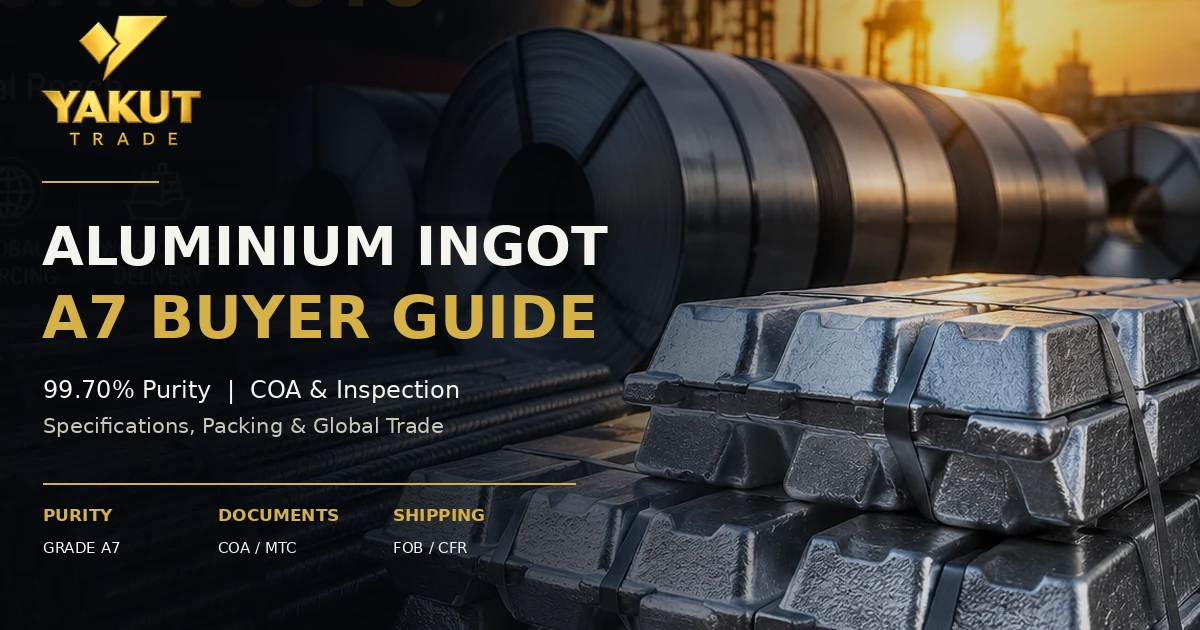
For a foundry, metal distributor or industrial procurement team, buying aluminium ingots internationally begins with a precise material specification—not a price quoted against an ambiguous grade name. The term aluminium ingot A7 commonly describes commercially pure primary aluminium with a minimum aluminium content of 99.70% by mass. Yet purity alone does not establish whether a particular shipment meets the iron, silicon, trace-element and documentation limits required by your production process.
This practical guide explains aluminium ingot A7 specifications, the relationship between A7 and other 99.7%-class designations, how to evaluate a certificate of analysis (COA), what to inspect before loading, and which commercial terms to define in a bulk purchase contract. It is written for international buyers who need a repeatable procurement process rather than an unverified offer.
Aluminium Ingot A7: Purity, Specifications & International Buying Guide
Check chemistry, smelter traceability, packing and delivery obligations before issuing a purchase order.
Aluminium A7 Specifications: The Quick Answer
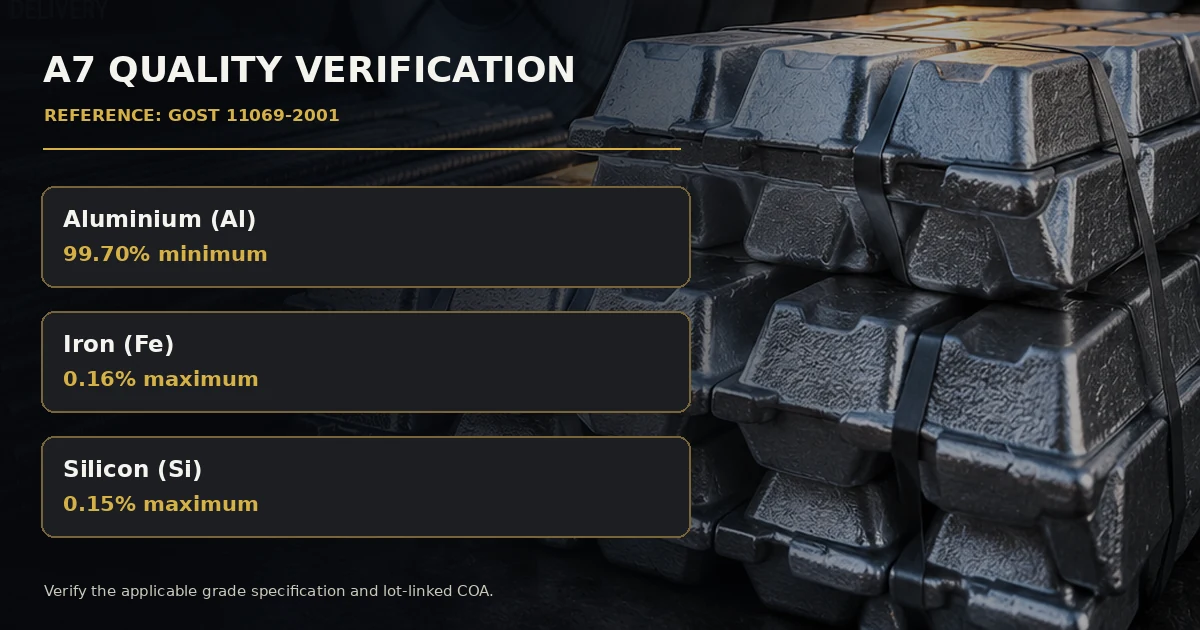
A7 generally means primary aluminium of at least 99.7% purity. A purchasing specification should also identify the applicable published standard, maximum Fe and Si, other element limits, metal form, packing, producer and test-document requirements. Do not assume that every offer labelled “A7”, “Al99.70”, “1070” or “P1020A” is interchangeable without comparing the actual chemical limits.
For a broader sourcing overview, see Yakut Trade’s steel, rebar and aluminium ingot supply portfolio. This article focuses specifically on technical selection and procurement of A7-class ingots.
1. What Is Primary Aluminium A7?
Primary aluminium is produced from alumina through an electrolytic smelting process and cast into forms suitable for transport, storage and further processing. A7-class ingots are commonly used as remelting feedstock. They are not a finished extrusion, rolling sheet or engineered casting alloy: a downstream producer normally adjusts alloy chemistry and processing conditions to achieve the final product’s properties.
The distinction matters in a purchase order. A buyer who needs an extrusion billet for a particular 6xxx-series alloy should not automatically substitute unalloyed A7 ingots. Similarly, a foundry that plans to manufacture an aluminium-silicon casting alloy must calculate its charge mix rather than assume A7 already contains the alloying additions it needs.
Why “99.7%” does not answer every quality question
Two lots may both contain at least 99.70% aluminium but have different distributions of the remaining elements. In practice, iron and silicon can influence downstream alloy chemistry, electrical performance, processing behaviour and acceptance against a customer’s product specification. The appropriate tolerance depends on the target alloy and the buyer’s process. Define the full chemistry in the contract, not only the headline purity.
2. A7, P1020A and Al99.70: Are They the Same Grade?
These labels are often placed together in commodity offers, but they refer to designation systems that require verification. A7 is commonly associated with the GOST designation; P1020A is a registered unalloyed aluminium composition designation; and Al99.70 appears in the Chinese GB/T 1196 designation system. The LME aluminium contract references registered compositions including P1020A and Al99.70, together with requirements for eligible brands and delivery. That does not make every privately offered A7 ingot an LME-deliverable warrant.
The London Metal Exchange’s official aluminium contract specification is a useful primary reference. It identifies P1020A and Al99.70 among the accepted chemical designations and specifies that physical delivery against the contract requires an LME-approved brand and warehouse.
| Label in an offer | What it generally indicates | Buyer verification |
|---|---|---|
| A7 | Commercial-purity primary aluminium, typically ≥99.7% Al | Request exact GOST edition or contractual chemical table. |
| P1020A | Registered unalloyed composition with defined impurity maxima | Check complete composition, producer and actual certificate. |
| Al99.70 | Designation under GB/T 1196 | Verify applicable edition and individual element limits. |
| “LME grade” | A marketing shorthand that needs substantiation | Confirm LME-approved brand and whether the transaction actually involves an LME warrant. |
Practical decision: if a supplier says “A7 equivalent to P1020A”, request the COA and compare the actual Fe, Si and other-element results against the precise P1020A limits in the contract. Equivalence should be established by chemistry and contractual acceptance criteria, not by a sales description.
3. Aluminium Ingot A7 Chemical Composition: What to Specify
The table below separates the widely used A7 purity description from an illustrative P1020A-type chemistry reference. It is not a certificate for material available from Yakut Trade, and it is not a substitute for the standard edition agreed by buyer and seller.
| Element / parameter | Illustrative P1020A-type reference | Why the buyer checks it |
|---|---|---|
| Aluminium (Al) | At least 99.70% (commercial class) | Base-metal purity and charge calculation |
| Silicon (Si) | Maximum 0.10% for P1020A | Downstream chemistry control |
| Iron (Fe) | Maximum 0.20% for P1020A | Downstream chemistry and process suitability |
| Zn, Ga, V and other traces | Limits depend on the referenced designation | Special product requirements and full compliance |
| Lot / heat traceability | Identifiable on certificate and packing | Connects lab results to delivered metal |
The reference Si and Fe values above are for P1020A, not a universal promise for all products sold as A7. Some A7 offers quote different individual impurity ceilings. When the required chemistry is tighter than a seller’s standard grade, request a written deviation review before accepting the offer.
Fe and Si: the two numbers to compare first
Iron and silicon are useful initial screening parameters because they appear prominently in common primary aluminium grade designations. However, a low Fe or Si figure by itself does not prove suitability for an electrical, food-contact or highly specialised application. Such end uses may require a particular finished alloy, processing route, certification or regulatory compliance beyond the ingot’s initial composition.
4. Typical Industrial Uses of A7-Class Ingots
Remelting and alloy preparation
Foundries and secondary processing plants may use primary aluminium ingots as a clean base charge before adding silicon, magnesium, copper or other alloying elements to reach a specified finished composition. The economic question is whether the input chemistry gives the plant enough room to adjust the melt without exceeding impurity limits.
Rolling and extrusion supply chains
Rolling and extrusion producers need tightly controlled upstream chemistry, but their final products usually require additional casting and processing into slab or billet. Buyers should distinguish a raw-ingot RFQ from an RFQ for ready-to-extrude billets or rolled products.
Industrial distribution and stockholding
Traders and metal distributors may procure ingots for onward industrial sale. For them, batch traceability, bundle integrity, predictable packaging and consistent certificate formats are often as important as nominal purity. A shipment that cannot be matched to its COA creates avoidable resale and claims risk.
5. How to Read an Aluminium Ingot Certificate of Analysis
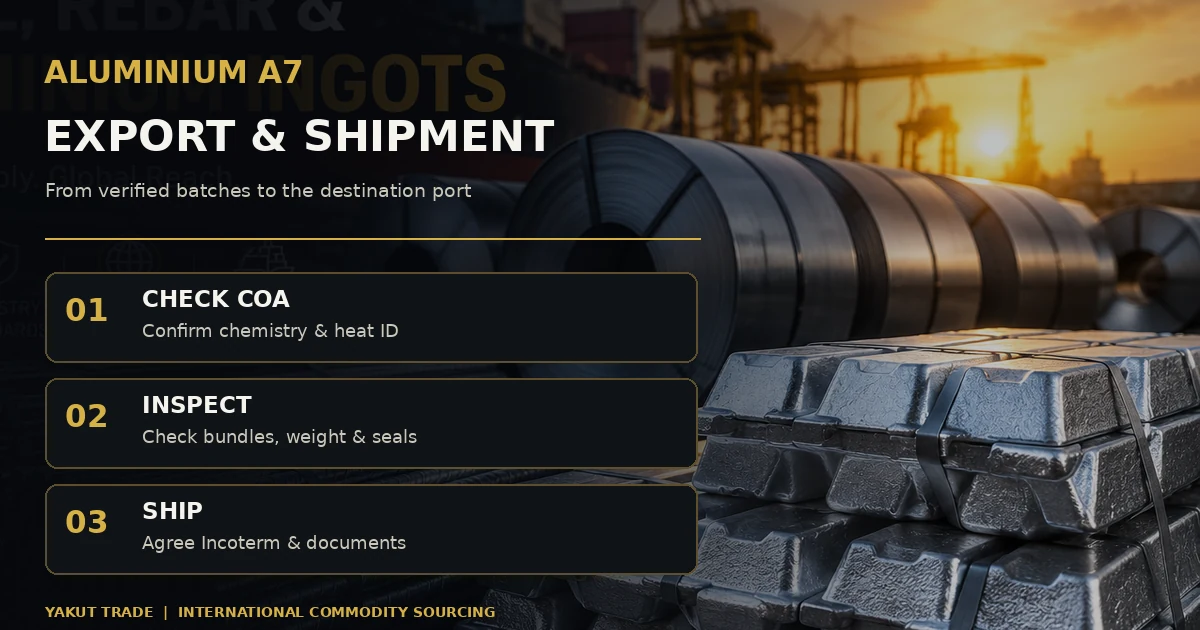
A credible COA is more than a table headed “Al 99.7%”. Ask for a document issued by the actual producer or an appropriately identified testing laboratory. It should make the sampled material and the declared results traceable to the commercial shipment.
- Producer identity: confirm the smelter or casting facility named on the document.
- Grade and standard: check the exact designation and standard edition rather than a generic “international standard” statement.
- Heat or batch number: link the certificate to bundle marks, production records and packing list.
- Element-by-element results: review measured Al, Fe, Si and other required elements, not only a pass/fail label.
- Test method and date: request laboratory or spectrometric method details when needed by your quality plan.
- Document authenticity: verify the issuer and signatures through an independently sourced contact channel.
Common red flag: a seller supplies one undated certificate for a proposed multi-container shipment without showing which lots it covers. Ask for lot allocation and a sampling plan before treating that certificate as evidence for the entire cargo.
6. Pre-Shipment Inspection: Quality, Quantity and Identity
Independent inspection can reduce uncertainty, but only if the contract specifies its scope, sampling method, timing and consequences of a failed result. A general “SGS inspection available” statement does not prove that an inspection has been ordered or completed.
Recommended inspection scope
- Verify producer, declared origin, grade and shipment identity.
- Compare bundle or ingot markings with packing list and COA.
- Check accessible surfaces for contamination, excessive dross or damage.
- Confirm net weight, bundle count, loading tally and container suitability.
- Witness sampling and testing if the purchase specification requires it.
- Record seal numbers, photographs and loading observations.
Define who appoints the inspector, who pays, where sampling takes place and whether the result is a condition of shipment or payment. A photograph of shiny ingots cannot establish chemical composition. A laboratory report cannot, by itself, confirm that the correct bundles were loaded. These checks complement rather than replace one another.
7. Ingot Weight, Bundling and Container Loading
Many commercial primary aluminium ingots weigh approximately 20–25 kg each and are strapped into larger handling bundles, often around one metric tonne. These are common market configurations, not guaranteed dimensions or packing weights for every A7 producer. Require the supplier’s packing specification for the actual lot.
For container shipments, verify the total gross mass, payload limits, axle and road restrictions, floor-load distribution, lashing arrangement, corrosion protection and applicable verified gross mass procedures. Dense metal can reach a container’s payload limit long before the container is physically full. A 40-foot container is not automatically the economical choice for heavy ingots.
Ask whether the cargo is supplied on pallets, in strapped free-standing bundles or in another approved configuration. Clarify how the receiver will unload it and whether wooden packaging needs treatment or marking under the importing country’s phytosanitary rules.
What should appear on the packing list?
At minimum, specify number of ingots and bundles, net and gross weights, marks, heat or lot numbers, dimensions or packing format, container numbers and seal numbers when applicable. This makes warehouse reconciliation, insurance claims and quality traceability more practical.
8. FOB, CFR and CIF: Choose Delivery Terms Carefully
International aluminium quotations commonly use Incoterms® 2020. Always name the location or port and the edition in the contract. Under FOB, CFR and CIF for sea transport, the risk of loss or damage generally transfers when the goods are on board the vessel at the port of shipment. CFR includes the seller’s freight obligation to the named destination port, while CIF additionally requires the seller to arrange the prescribed insurance coverage. Neither CFR nor CIF means the seller carries transit risk all the way to the destination port.
For containerized cargo delivered to a terminal before vessel loading, ask your freight adviser whether FCA, CPT or CIP is a better operational fit. See the International Chamber of Commerce’s Incoterms® 2020 guidance for the official framework.
| Term | Commercial emphasis | Question to ask |
|---|---|---|
| FOB | Buyer arranges main sea carriage | Which exact port and loading obligations apply? |
| CFR | Seller contracts freight to destination port | Which destination costs are excluded? |
| CIF | Seller contracts freight and required insurance | Is the insurance coverage sufficient for this cargo? |
9. What Determines an International A7 Aluminium Quote?
Comparing two offers requires more than checking the headline price per tonne. Market quotations may reference an LME aluminium price over an agreed pricing period plus or minus a negotiated physical premium. The premium and total landed cost can vary with producer brand, regional supply, origin, grade, shipment size, freight, insurance, financing, taxes and destination requirements.
Before comparing offers, align the currency, pricing date or average period, net versus gross weight basis, Incoterm, named port, inspection cost, payment instrument and documentary requirements. An apparently lower price may exclude freight, testing or terminal charges that another quotation includes.
Yakut Trade does not publish a fixed A7 ingot price or promise stock availability in this guide. For an offer matched to a specific requirement, submit the grade, tonnage, destination and commercial terms through the trade enquiry page.
10. Buyer RFQ Checklist: Information That Produces a Usable Offer
Copy these requirements into your next A7 aluminium ingot RFQ:
- Material: primary aluminium ingot A7 or exact alternative designation.
- Standard: named specification and edition, with required full chemical limits.
- Quality: minimum Al percentage; maximum Fe, Si and any restricted trace elements.
- Quantity: target metric tonnes, lot tolerance and purchase frequency.
- Producer and origin: preferred or restricted origins; brand requirements if relevant.
- Form and packing: ingot size, bundle configuration, marking and handling needs.
- Evidence: producer COA, lot traceability, inspection and test scope.
- Delivery: named port or place, Incoterms® 2020 rule and target shipment window.
- Commercials: price basis, currency, payment method and document set.
- Compliance: import rules, sanctions screening, origin evidence and any applicable emissions reporting.
Sending a complete RFQ reduces avoidable clarification rounds and makes competing offers easier to compare on a like-for-like basis. If a supplier cannot identify the producer or provide a credible sample COA, treat the offer as preliminary rather than confirmed supply.
11. Supplier Verification and Transaction Risk
Primary aluminium is a high-value commodity. Before making a payment commitment, confirm the seller’s legal identity, authority to sell the metal, production or allocation evidence, and the relationship between the commercial seller, smelter and warehouse. Independently verify beneficiary banking details and investigate any unexplained changes to payment instructions.
Separate the quality risk of off-spec metal from the performance risk of non-delivery. A good COA does not establish that the seller controls the cargo, and a convincing warehouse photograph does not establish the chemical grade. The contract should describe acceptance criteria, document release, inspection rights, claims procedure and dispute resolution.
Yakut Trade works in international commodity trading and can support sourcing coordination and transaction-related documentation review according to the specific engagement. Buyers who need a broader counterparty assessment can review the company’s supplier verification services.
Frequently Asked Questions About Aluminium Ingot A7
What is the minimum purity of aluminium ingot A7?
A7-class primary aluminium is generally described as containing at least 99.70% aluminium by mass. The complete impurity limits must be confirmed against the contractually named standard and the actual lot COA.
Is A7 the same as P1020A?
They may be marketed as comparable 99.7%-class products, but a buyer should compare the exact chemical limits. P1020A has defined element maxima, including 0.10% silicon and 0.20% iron. Do not assume interchangeability without the certificate and contract.
Which impurities matter most when buying A7 ingots?
Iron and silicon are common first checks. The buyer must also assess any additional elements relevant to the target alloy or manufacturing process and ensure the complete chemical specification is met.
How much does one aluminium ingot weigh?
Commercial ingots often weigh about 20–25 kg, but dimensions and weights differ by producer and casting format. Obtain the actual packing list and confirm bundle weight before planning freight or unloading.
What documents should accompany an international shipment?
Depending on the transaction, buyers commonly require a commercial invoice, packing list, transport document, certificate of origin where applicable, lot-linked COA and agreed inspection records. Additional import and compliance documents depend on destination.
Can an A7 ingot offer be priced against the LME?
A quotation may use an LME reference and a negotiated physical premium, but the parties must agree the pricing period, currency, delivery basis and all other charges. An LME-linked quotation does not itself prove that the offered metal is an LME-approved deliverable brand.
Source Aluminium Ingots with Clear Specifications
Share your A7 chemistry requirements, required volume, destination, delivery term and inspection preferences with Yakut Trade. Our team can review the commercial requirement and discuss available sourcing and transaction-support options, subject to supplier confirmation and contract.
Send RFQ / Submit Your Trade Requirement
Commercial enquiries: sales@yakuttrade.com
Technical sources: GOST 11069-2001 chemical composition of A7; London Metal Exchange aluminium contract specifications. Technical reference note: this guide explains grade-selection and procurement principles. Final acceptance must follow the agreed specification, applicable edition and independently verifiable shipment documents.