
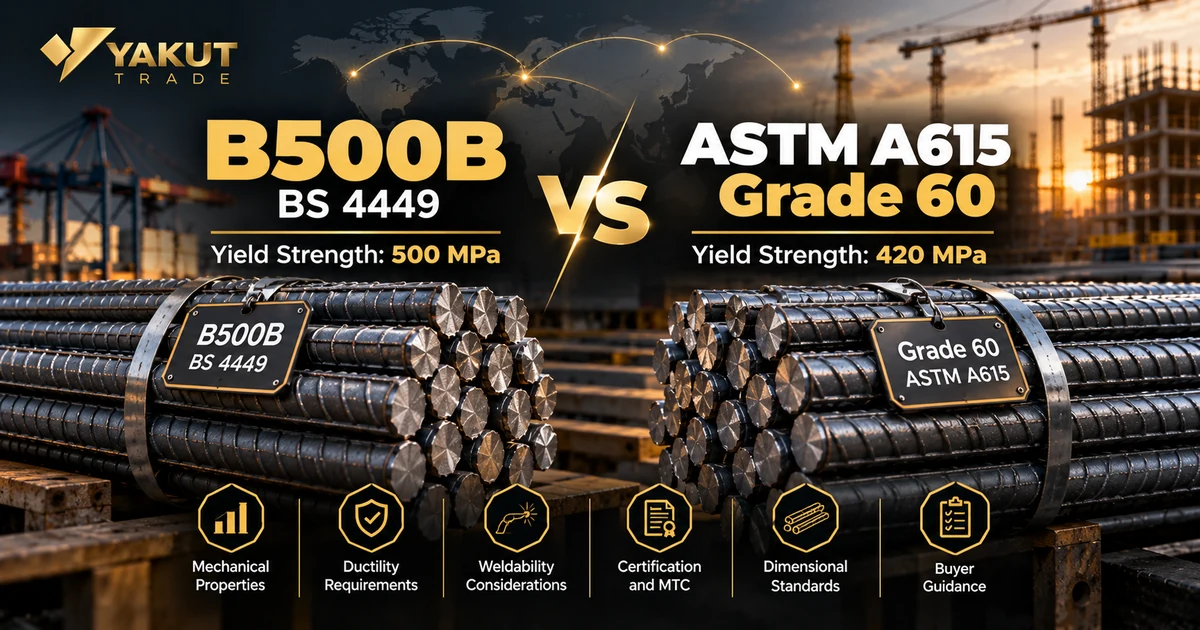
B500B vs ASTM A615 Grade 60: Key Differences for International Rebar Buyers
B500B and ASTM A615 Grade 60 are widely recognized reinforcing steel specifications, but they differ in yield strength, ductility requirements, weldability provisions and compliance procedures. Understanding these differences helps international buyers avoid unsuitable material substitutions and costly procurement mistakes.
Steel rebar suppliers may offer B500B under BS 4449, ASTM A615 Grade 60, ASTM A706 reinforcement or other national specifications. Although these products can serve similar structural functions, they are not automatically interchangeable.
The difference between B500B vs ASTM A615 Grade 60 is particularly important for construction contractors, infrastructure developers, engineering procurement teams and steel distributors operating across multiple regulatory markets.
A reinforcement bar that meets an ASTM specification does not automatically satisfy BS 4449, and a B500B bar cannot be assumed to comply with an ASTM specification merely because it has a higher specified yield strength.
This guide compares the two standards from a procurement perspective, including mechanical properties, ductility, weldability, mill certification, dimensional requirements, inspection and commercial documentation.
Quick Answer: B500B or ASTM A615 Grade 60?
B500B Rebar
Specified characteristic yield strength of 500 MPa with Class B ductility requirements. Consider when the approved project documentation requires B500B or an accepted equivalent under the applicable engineering code.
Grade 60 Rebar
Specified minimum yield strength of 60,000 psi, designated 420 MPa in the SI standard. Consider when ASTM A615 Grade 60 is explicitly permitted by the project specification and structural design.
Important: Neither standard is universally superior. The project-approved standard, structural design and required performance must determine the purchasing decision.
B500B vs ASTM A615 Grade 60: Comparison Table
The table below summarizes the most important distinctions that international steel buyers should understand before requesting quotations.
| Property | B500B | ASTM A615 Grade 60 |
|---|---|---|
| Main Standard | BS 4449 | ASTM A615/A615M |
| Steel Classification | Weldable reinforcing steel, Class B ductility | Carbon-steel reinforcement |
| Specified Yield Strength | 500 MPa characteristic | 420 MPa minimum (SI designation) |
| Ductility | Defined Class B requirements | Standard-specific elongation and bend requirements |
| Tensile-to-Yield Ratio | Minimum Rm/Re of 1.08 | Check applicable tensile requirements; not directly equivalent to B500B classification |
| Elongation | Minimum Agt of 5% | Requirements depend on bar size and standard test method |
| Weldability | Chemical and weldability controls within BS 4449 | Welding requires particular caution and appropriate qualification |
| Dimensions | Metric dimensional system | ASTM bar number and dimensional system |
| Certification | BS 4449 conformity; EN 10204 documents where specified | ASTM test reports and certificates as contractually required |
These figures describe selected requirements of the referenced grade systems. Final acceptance must use the complete applicable edition, project specification and relevant test results.
What Is B500B Reinforcement Steel?
B500B is a reinforcing steel grade associated with BS 4449, the British Standard for weldable reinforcing steel used in concrete construction.
The designation identifies a characteristic yield strength of 500 MPa and Class B ductility performance.
BS 4449 distinguishes three principal ductility classes: B500A, B500B and B500C. They share the same characteristic yield strength, but their ductility requirements differ.
B500B Mechanical Properties
Important characteristics include:
- Characteristic yield strength of 500 MPa.
- Minimum tensile-to-yield strength ratio (Rm/Re) of 1.08.
- Minimum total elongation at maximum force (Agt) of 5%.
- Bending and rebending requirements according to the applicable standard.
- Specified controls related to weldability and chemical composition.
These properties should be verified using the current applicable edition of BS 4449 and the mill’s actual conformity documents.
Where Is B500B Used?
B500B may be specified for reinforced concrete structures, commercial buildings, infrastructure projects, foundations, bridges and other construction applications designed around suitable reinforcement requirements.
The relevant design code and project specification must still establish whether this grade is acceptable for a particular structural element or jurisdiction.
What Is ASTM A615 Grade 60 Rebar?
ASTM A615/A615M specifies requirements for deformed and plain carbon-steel reinforcing bars for concrete construction.
Grade 60 is one of the most widely recognized ASTM rebar designations. The number refers to the specified minimum yield strength of 60,000 psi, represented by Grade 420 in the SI designation.
Under ASTM A615, buyers should evaluate the required mechanical tests, bar dimensions, deformation requirements, bend testing, identification and chemical analysis.
ASTM A615 Grade 60 Key Characteristics
- Minimum yield strength corresponding to Grade 60 [420].
- Specified tensile strength and elongation requirements.
- Deformation characteristics for bonding with concrete.
- Bend-test requirements under the applicable specification.
- Bar identification and traceability requirements.
Unlike B500B, ASTM A615 is not organized around the same A, B and C ductility-class system. Buyers must therefore compare the actual requirements rather than assuming equivalent ductility based on a grade label.
1. Yield Strength: 500 MPa vs 420 MPa
Yield strength describes the stress at which steel begins to undergo significant permanent plastic deformation under the applicable test conditions.
It is an important property in the design and assessment of reinforced concrete structures.
Characteristic Yield Strength
Specified Minimum Yield Strength in SI
B500B has a higher specified yield-strength value than ASTM A615 Grade 60. However, this difference does not automatically mean B500B is the better choice for every project.
Structural calculations, reinforcement detailing, development lengths, serviceability, fatigue, seismic requirements and construction rules must be considered under the applicable design code.
Procurement Principle
Higher specified yield strength does not authorize an automatic substitution or reduction in reinforcement quantity. Such changes must be reviewed and approved through the project engineering process.
2. Ductility: Why the Difference Matters
Ductility is the capacity of steel to undergo plastic deformation before failure. It is particularly relevant when evaluating reinforcement performance under demanding structural loading.
For B500B, the standard defines a ductility class that includes requirements for the tensile-to-yield strength ratio and elongation at maximum force.
ASTM A615 Grade 60 also includes mechanical performance requirements, but these are not expressed using the same B500B ductility classification.
What Is the Rm/Re Ratio?
The Rm/Re ratio compares tensile strength with yield strength. It helps describe the strength reserve available after yielding.
For B500B, a minimum ratio of 1.08 is part of the grade’s ductility requirements.
What Is Agt?
Agt represents total percentage elongation at maximum force. It is used to characterize the deformation capability of reinforcing steel before the maximum tensile load is reached.
B500B specifies a minimum Agt of 5%.
Buyers should not directly compare Agt with an ASTM elongation-at-fracture value without checking the testing definitions, gauge length and applicable standard requirements.
Why Ductility Affects Procurement
Ductility requirements can be particularly important for projects where engineers must account for structural redistribution, deformation capacity and seismic performance.
However, neither standard designation alone guarantees that a product is acceptable for every seismic or highly demanding structural application. The project engineer must confirm all design-code and reinforcement requirements.
3. Weldability: Can B500B and ASTM A615 Grade 60 Be Welded?
Weldability is another important distinction between the two products.
BS 4449 covers weldable reinforcing steel and includes relevant chemical-composition controls. Nevertheless, welding B500B should still follow the applicable approved procedures and engineering requirements.
ASTM A615 includes an important caution regarding welding because the specification does not contain dedicated provisions intended to enhance weldability.
When welding ASTM A615 reinforcement is proposed, the relevant material chemistry, carbon equivalent where applicable, preheating requirements, filler materials and qualified welding procedures must be assessed.
What About ASTM A706?
ASTM A706/A706M is a separate specification for low-alloy reinforcing steel with controlled chemical and mechanical requirements intended to enhance weldability and support specified applications.
For projects involving welded reinforcement or particular ductility requirements, engineers may specify ASTM A706 rather than ASTM A615. The final choice should follow the project design and welding code.
4. Rebar Diameter, Weight and Dimensional Standards
Reinforcement steel can be purchased using different size designation systems.
B500B is commonly specified using nominal metric diameters, while ASTM A615 products use ASTM bar-number designations and corresponding standardized nominal dimensions.
For example, an ASTM #5 bar has a nominal diameter of approximately 15.9 mm. This is close to a 16 mm metric rebar, but buyers should not assume that the products have identical nominal mass, rib geometry, dimensional tolerances or certification requirements.
What to Confirm Before Ordering
- Exact bar designation and nominal diameter.
- Specified length and permissible tolerance.
- Nominal or actual weight basis.
- Required rib or deformation characteristics.
- Acceptable manufacturing and bending tolerances.
- Bar markings and identification method.
When comparing prices across two standards, buyers should first ensure that the offers represent the correct dimensions and approved technical requirements.
5. Can B500B Replace ASTM A615 Grade 60?
This is one of the most commercially important questions for international construction-material buyers.
The answer is not without project-specific engineering approval.
Although B500B has a higher specified yield-strength value, the two grades are governed by different standards and may have different requirements for tensile behavior, weldability, chemical composition, marking, bonding characteristics and acceptance testing.
Any proposed substitution should be assessed against the project’s structural drawings, design assumptions, applicable construction code and contractual specification.
Before Approving a Rebar Substitution
- Obtain the project-approved reinforcement specification.
- Confirm that substitution is permitted by the project authority.
- Compare yield, tensile, ductility and deformation requirements.
- Review bar diameter, nominal mass and detailing implications.
- Confirm welding and splice requirements.
- Review applicable conformity assessment and certification.
- Obtain written engineering approval before purchase or installation.
6. B500B vs ASTM A615 Grade 60: Which Should Buyers Choose?
The appropriate choice depends primarily on the technical standard specified by the project owner, engineer or local construction authority.
Choose B500B When:
- The approved project specification requires BS 4449 B500B.
- Class B ductility requirements are part of the design.
- The relevant national or project certification requirements can be met.
- The producer can supply traceable material and suitable conformity documentation.
Choose ASTM A615 Grade 60 When:
- The approved project specification permits ASTM A615 Grade 60.
- The structural design uses the relevant Grade 60 properties.
- The required bar dimensions and mechanical properties can be supplied.
- The supplier can provide valid ASTM-compliant documentation and inspection records.
If the project is still in the design or procurement planning stage, the engineer should establish the acceptable standards before the purchasing department begins commercial negotiations.
7. Mill Test Certificates: What Should International Buyers Verify?
A Mill Test Certificate (MTC) or Mill Test Report (MTR) provides important information about the properties and identification of a steel shipment.
Before accepting B500B or ASTM A615 Grade 60 rebar, the buyer should verify that the supplier’s certificate corresponds to the actual product and the applicable contract specification.
| MTC Information | Buyer Verification |
|---|---|
| Producing Mill | Confirm the actual manufacturer’s identity. |
| Standard & Edition | Check the specified standard and applicable revision. |
| Steel Grade | Verify B500B or ASTM A615 Grade 60 as ordered. |
| Heat Number | Match the production reference to the shipped bundles. |
| Chemical Analysis | Review composition against the applicable requirements. |
| Yield & Tensile Results | Compare the test results with the grade specification. |
| Elongation / Ductility | Confirm correct test definitions and acceptance limits. |
| Bend / Rebend Results | Review required test compliance. |
EN 10204 Type 3.1 and Type 3.2
For transactions requiring inspection documents under EN 10204, the buyer may specify Type 3.1 or Type 3.2 certification.
Type 3.1 documents contain specific inspection results validated by an authorized inspection representative of the manufacturer who is independent of the manufacturing department.
Type 3.2 involves additional validation by an authorized purchaser representative or an inspector designated under applicable official regulations.
These certificate types should be requested only when relevant to the transaction. They do not by themselves prove that a material complies with every requirement of BS 4449 or ASTM A615.
8. Pre-Shipment Inspection for B500B and ASTM Grade 60
Independent inspection can be important for high-volume purchases, critical infrastructure projects or transactions involving a new supplier.
Depending on the contract, a qualified third-party inspection provider may verify relevant aspects of product quality, dimensional compliance, marking, quantity and loading.
Recommended Inspection Scope
- Verify rebar grade and standard against the purchase contract.
- Inspect bar markings and bundle identification.
- Check nominal diameter and relevant dimensional requirements.
- Review MTC authenticity and heat-number traceability.
- Witness mechanical testing where contractually required.
- Verify packing, bundle count and shipping quantity.
- Inspect loading and cargo-securing arrangements.
The buyer should agree in advance on test methods, acceptance criteria, inspection costs, handling of rejected material and reporting procedures.
For wider purchasing controls, see our international steel rebar buying guide.
9. Does B500B Cost More Than ASTM A615 Grade 60?
There is no fixed international price relationship between these two reinforcement grades.
Steel rebar quotations are influenced by producing mill, origin, diameter, production costs, technical requirements, certification, order size, market conditions and delivery arrangements.
A higher-strength or more tightly specified product does not automatically carry the same premium in every market.
Buyers should request quotations based on the exact approved project requirements before comparing commercial terms.
Compare Quotations on the Same Basis
For a fair commercial comparison, verify:
- Correct standard and steel grade.
- Required diameter and bar length.
- Quantity and weight basis.
- Origin and producing mill.
- Required mill and third-party certification.
- Packaging and loading method.
- Shipment schedule.
- Incoterm and destination.
- Payment conditions.
Commercial Buyer Rule
A lower USD/MT offer is not a valid saving if the material cannot be accepted under the project’s approved technical specification.
10. How to Verify a Rebar Supplier Before Ordering
Technical compliance must be supported by a commercially capable supplier.
Whether the counterparty is a producing mill, authorized distributor or independent trader, buyers should confirm the company’s identity, commercial authority and realistic ability to supply the specified steel.
Supplier Due Diligence Checklist
- Confirm the supplier’s registered company identity.
- Identify whether the seller is a producer, distributor or trader.
- Request manufacturer information and relevant product documentation.
- Verify the grade, origin and available supply quantity.
- Review sample mill certificates and product markings.
- Confirm inspection and loading arrangements.
- Check contractual seller and banking information.
- Assess the proposed payment and delivery structure.
Buyers requiring additional counterparty assessment can review Yakut Trade’s supplier verification services before committing to a major international purchase.
11. International Shipping Considerations for Rebar
The physical handling requirements of B500B and ASTM A615 Grade 60 are broadly similar when supplied in comparable bar lengths and bundles.
Shipping costs depend mainly on cargo volume, dimensions, weight, packing method, origin, destination and available transport equipment.
Bulk steel shipments may move as breakbulk cargo, while suitable lengths and quantities may be transported in containers.
When comparing FOB, CFR or CIF offers, confirm the named port, loading responsibilities, main carriage, insurance and destination charges.
For containerized shipments, the parties should also consider whether an Incoterm such as FCA is more appropriate under Incoterms 2020.
Before shipment, ensure bundle tags and shipping documents identify the contracted standard and grade accurately.
A Practical 5-Step Rebar Grade Selection Process
01
Confirm Design
Identify the approved engineering standard and grade.
02
Compare Properties
Check yield strength, ductility, chemistry and weldability.
03
Review Documents
Confirm MTC, grade identification and traceability.
04
Verify Supplier
Review producer, availability and transaction readiness.
05
Send RFQ
Request quotation for the exact approved specification.
How Yakut Trade Supports International Rebar Buyers
Yakut Trade supports international buyers sourcing reinforcement steel and other industrial metals through structured commercial sourcing and trade coordination.
Our approach begins with understanding the required grade, standard, quantity, destination and commercial conditions before evaluating relevant supply opportunities.
Review the specified grade, standard, dimensions and order quantity.
Evaluate commercially relevant supply and manufacturer documentation.
Support communication and agreed commercial documentation stages.
Explore our steel, rebar and aluminium supply solutions for international industrial buyers.
B500B / ASTM A615 Grade 60 RFQ Checklist
Providing complete technical and commercial information helps reduce unsuitable offers and accelerates supplier evaluation.
Frequently Asked Questions About B500B vs ASTM A615 Grade 60
Conclusion: Which Rebar Standard Should International Buyers Select?
The decision between B500B and ASTM A615 Grade 60 should always begin with the engineering specification.
B500B offers a characteristic yield strength of 500 MPa and defined Class B ductility requirements, while ASTM A615 Grade 60 uses a minimum yield-strength designation of 420 MPa in SI and follows a different set of mechanical, chemical and certification rules.
Neither material should be substituted for the other without appropriate engineering approval.
For international buyers, the most reliable purchasing process combines the correct technical specification with authenticated mill documentation, clear inspection terms, supplier due diligence and realistic delivery arrangements.
The objective is not simply to buy steel at the lowest USD/MT price. It is to purchase reinforcement that is acceptable for the project and can be delivered under a commercially reliable transaction structure.
Need B500B or ASTM A615 Grade 60 Rebar?
Submit your required standard, rebar grade, diameter, quantity, destination and delivery terms. Yakut Trade can review relevant steel supply opportunities and commercial availability for your project.
For commercial inquiries: sales@yakuttrade.com
Product availability, quotation terms and inspection arrangements depend on actual specifications and current market conditions.