
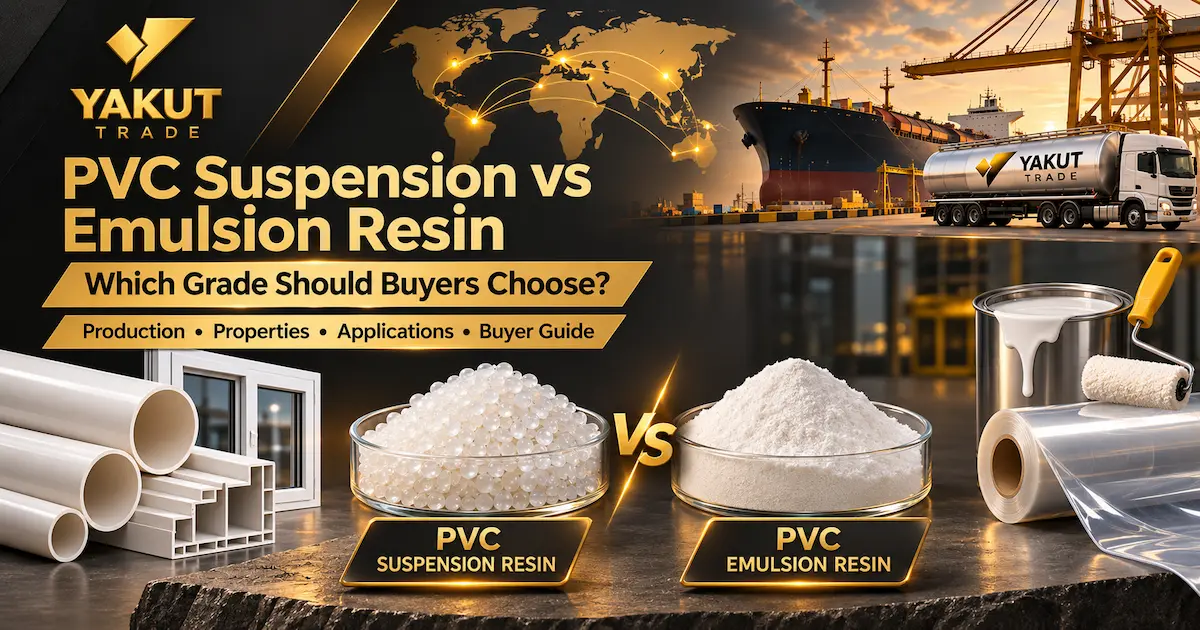
For manufacturers and international procurement managers, suspension PVC vs emulsion PVC is a processing decision—not simply a comparison between two prices for a white resin. A product suitable for rigid pipes and window profiles may be a poor match for a plastisol coating line. Conversely, a fine dispersion-grade resin may be unnecessary or commercially unsuitable for ordinary rigid-PVC extrusion.
Before requesting a bulk quotation, buyers should define the finished application, processing equipment, resin particle characteristics, K-value, technical documentation and destination-market compliance. This guide explains how S-PVC and E-PVC differ, where each is typically used, and what to verify in a supplier’s Technical Data Sheet (TDS) and Certificate of Analysis (COA).
PVC Suspension vs Emulsion Resin: Which Grade Should Buyers Choose?
Compare production method, particle size, PVC K-value, plastisol performance and industrial applications before placing a bulk resin order.
Quick Answer: S-PVC or E-PVC?
SUSPENSION PVC (S-PVC)
For Dry Blending & Melt Processing
Often selected for rigid pipe, profiles, fittings, sheets and compounded PVC applications using extrusion, injection molding or calendering, subject to the exact grade.
EMULSION / DISPERSION PVC (E-PVC)
For Plastisols & Coatings
Often selected when fine dispersion resin is mixed with plasticizers to produce plastisols for coated fabrics, flooring, artificial leather, dipping and related specialty applications.
Important qualification: “Paste PVC” is a commercial description for dispersion-grade resin. Depending on the producer, paste resin can be manufactured using emulsion or micro-suspension techniques. Buyers should verify the actual resin type and published TDS rather than rely on a trade label alone.
PVC Suspension vs Emulsion: Side-by-Side Comparison
The comparison below describes typical resin families; it does not claim that every producer’s grades have identical parameters.
| Procurement factor | Suspension PVC (S-PVC) | Emulsion / dispersion PVC (E-PVC) |
|---|---|---|
| Polymerization route | Suspension process, with vinyl chloride dispersed as droplets in a liquid medium | Emulsion or related dispersion/paste-resin manufacturing route |
| Typical physical form | Free-flowing granular resin or powder with comparatively larger particles | Fine powder with a dispersed particle structure developed for plastisols |
| Common processing route | Dry blend or compound, followed by fusion and melt processing | Plasticizer dispersion, then coating/dipping/casting and thermal gelation/fusion |
| Typical industrial uses | Rigid pipe, profiles, fittings, sheet and selected flexible compounds | Coated fabrics, synthetic leather, flooring, sealants and other plastisol products |
| Critical TDS data | K-value, bulk density, particle-size distribution, volatile matter, contamination and plasticizer absorption | K-value, plastisol viscosity and aging, particle properties, gelation/fusion behavior and filtration |
| Supplier qualification | Confirm application grade and extrusion/injection suitability | Confirm dispersion-grade classification and plastisol processing performance |
| Can one replace the other? | Only after qualified formulation and line trials | Only after qualified formulation and line trials |
1. What Is Suspension PVC (S-PVC)?
Suspension polyvinyl chloride is produced by polymerizing vinyl chloride monomer in dispersed droplets, yielding resin particles intended for conventional thermoplastic processing. It is a broadly used form of PVC resin in industrial manufacturing. S-PVC itself is not one homogeneous product: grades vary in molecular characteristics, particle properties, absorption, additives and processing performance.
Where S-PVC Is Commonly Used
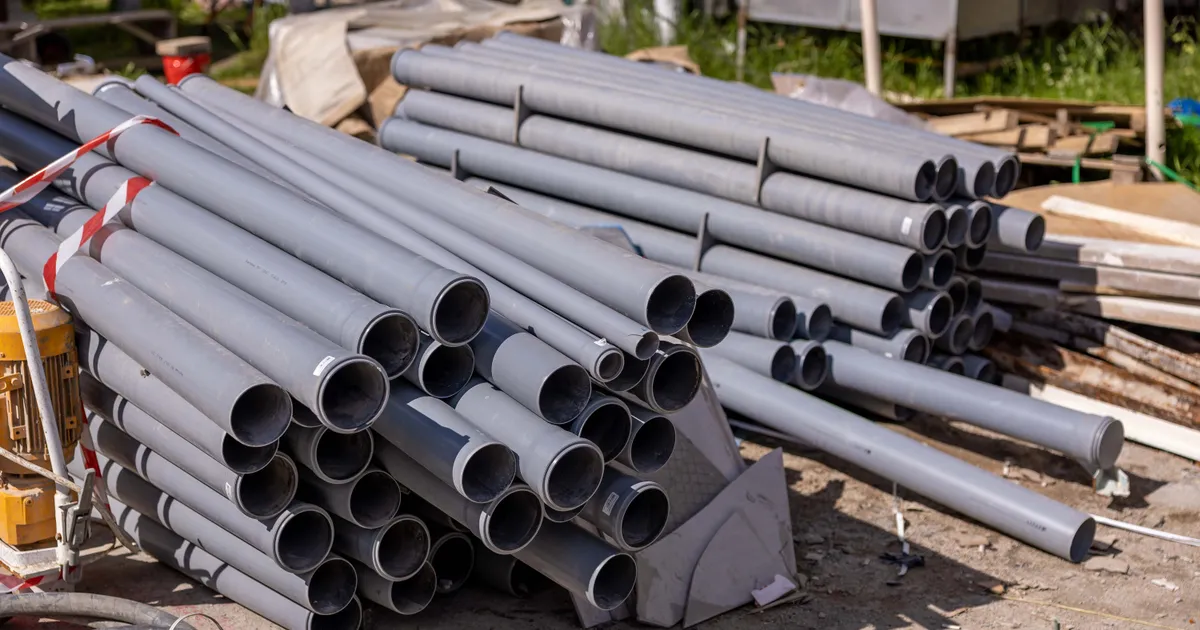
- Pipes and profiles: grades selected for rigid PVC extrusion, with suitable formulation and stabilization.
- Injection-molded fittings: grades that match the injection process, compound flow and mechanical requirements.
- Sheets and profiles: extrusion or calendering applications where dimensional control and surface finish matter.
- Flexible PVC compounds: appropriate suspension grades can be compounded with plasticizers for cable, film and other applications.
PVC-S resins are typically blended with stabilizers, processing aids and other components according to their target end use. Uncompounded PVC powder should not be confused with a finished PVC compound that is ready for direct molding or extrusion.
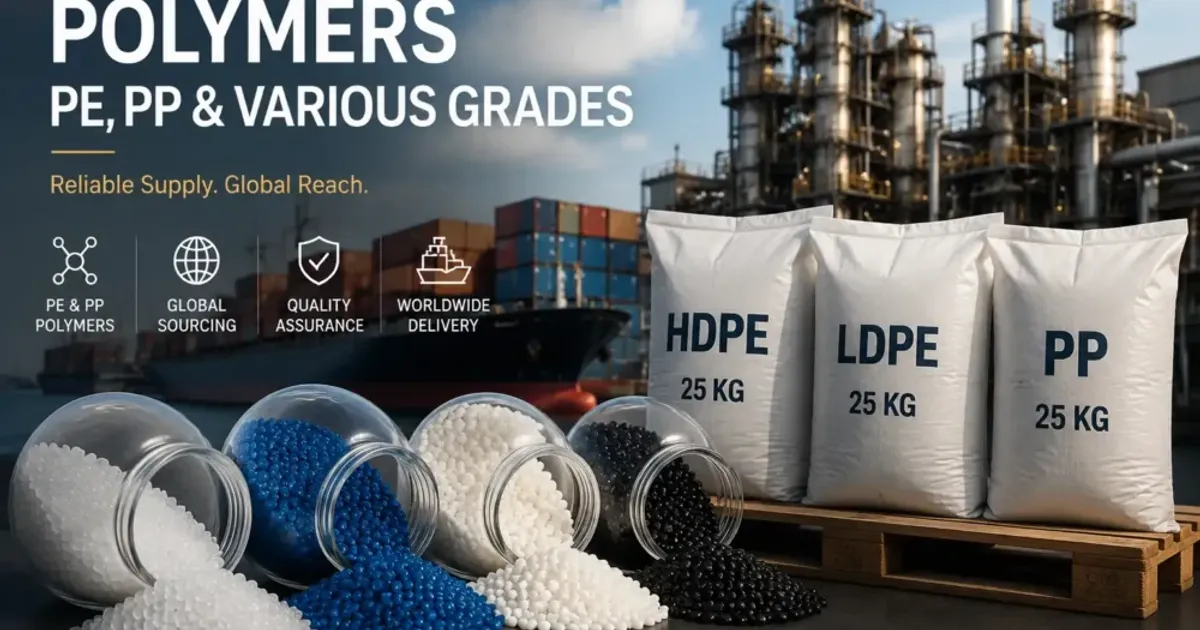
For a broader view of Yakut Trade’s polymer sourcing activities, explore the industrial polymer supply portfolio. This page remains the commercial product hub; the present article is dedicated to PVC grade selection.
2. What Is Emulsion PVC (E-PVC) or PVC Paste Resin?
Emulsion and dispersion PVC are associated with finer particle systems. Commercial paste resins are developed to disperse in plasticizers, creating a flowable formulation called a plastisol. When adequately heated under controlled conditions, the resin gels and fuses to form the intended material.
Commercial producers may supply paste/dispersion resin made by emulsion, micro-suspension or related methods. Accordingly, a buyer should ask whether the offered material is a true dispersion-grade resin and whether its rheology and end-use performance have been validated for the intended process.
Typical E-PVC / Paste PVC Applications
- Coated textiles, artificial leather and synthetic upholstery.
- Certain flooring and wall-covering layers.
- Plastisol dipping, coating and casting.
- Automotive underbody coatings, specialized sealants and related industrial products.
- Other specialty formulations requiring carefully controlled paste viscosity and fusion.
The formulation may contain a plasticizer, heat stabilizer, pigment, filler and other additives. Resin selection alone does not determine the properties of the final plastisol. A buyer needs grade-specific rheology and production-trial evidence, not a generic claim that all emulsion resins behave the same way.
3. Why Particle Size and Structure Matter
S-PVC typically has a larger particle structure optimized for dry blending and subsequent melt processing, while dispersion-grade PVC uses much finer particles and a different morphology designed to create stable plastisols. These structural differences influence powder handling, plasticizer uptake, initial paste viscosity and the way the material develops its final properties during processing.
The relevant laboratory measure is not always a single average particle diameter. Buyers may also need distribution data, agglomerate behavior, sieve residues and a manufacturer-specific measure of dispersion or paste performance.
4. PVC K-Value: Useful, but Not Enough
K-value is a viscosity-based characteristic related to PVC molecular mass. It helps procurement teams shortlist grades by processing and performance requirements. However, it is not a universal statement of mechanical quality, and the same K-value does not mean two resins have interchangeable particle morphology or paste behavior.
The published ISO 1628-2:2020 standard describes determination of viscosity number and K-value of PVC resins. Buyers should request the test method and confirm how a supplier reports the value; a new revision was under development in 2026, so the contract should name the applicable published edition rather than casually reference a draft.
Typical Grade-Selection Logic
- For extrusion and molding, evaluate the specified suspension resin’s K-value alongside melt-processing performance and compound requirements.
- For plastisols, evaluate the emulsion/paste resin’s K-value alongside plasticizer dispersion, Brookfield viscosity, viscosity after storage and fusion performance.
- For any change from one producer to another, request processing trials and technical approval before ordering large volumes.
K57, K65 and K67 may appear in suspension-grade commercial discussions, but buyers should avoid treating these names as complete product specifications. The appropriate choice depends on application, producer data and validated process conditions.
5. Which Resin Fits Pipes, Profiles, Coated Fabric or Flooring?
The correct answer begins with the end product. A pipe extrusion plant and a plastisol coating operation have different equipment, fusion behavior, handling requirements and quality criteria.
| End product / process | Starting-point resin family | Critical qualification |
|---|---|---|
| Rigid PVC pipe extrusion | Usually an approved S-PVC extrusion grade | K-value, compound formulation, thermal stability, pipe standard, production trial |
| Window and building profiles | Usually an S-PVC profile grade | Surface finish, weathering formulation, dimensional stability, machine compatibility |
| Injection-molded fittings | Appropriate S-PVC injection/compounding grade | Melt flow, mold filling, stabilizer package and physical tests |
| Artificial leather / coated fabric | Often E-PVC / paste resin | Plastisol viscosity, coating thickness, fusion and mechanical properties |
| Plastisol flooring | Often suitable dispersion / paste PVC | Viscosity, spreadability, gelation and wear-related specification |
| Specialty coatings or dipping | Relevant E-PVC / dispersion grade | Rheology, storage stability, substrate compatibility and thermal cycle |
6. How to Read a PVC Resin TDS and COA
A manufacturer TDS normally reports typical values and test methods. A COA should identify actual measured values for the relevant batch or lot, where such measurements are part of the supply agreement. Procurement decisions should not rely on a marketing brochure alone.
| Parameter to request | For suspension resin | For emulsion / paste resin |
|---|---|---|
| Grade and manufacturing identity | Precise grade number, manufacturer and route | Precise dispersion/paste designation, manufacturer and route |
| K-value / viscosity number | Method and measured value | Method and measured value |
| Particle data | Size distribution, sieve, bulk density | Fine-particle characteristics and residue control |
| Moisture / volatile matter | Agreed maximum and test method | Agreed maximum and test method |
| Processing-related data | Plasticizer absorption, dry blend behavior, fish-eyes where relevant | Initial and aged plastisol viscosity, gelation/fusion requirements |
| Compliance | Residual VCM, restrictions and end-use documents where applicable | Residual VCM, restrictions and end-use documents where applicable |
| Traceability | Batch/lot number linked to packaging | Batch/lot number linked to packaging |
For sensitive applications, additional regulatory or material-safety testing may apply. Certain stabilizers, plasticizers and residual contaminants can have end-use or destination-specific restrictions. These requirements should be checked separately from the base-resin technical sheet.
7. Plastisol Viscosity, Storage Stability and Fusion
For a paste PVC purchase, plastisol rheology is often one of the decisive attributes. The same resin can behave differently depending on the plasticizer, additive package, solids loading and mixing method. Suppliers and buyers therefore need agreed test formulations when comparing resin grades.
- Initial viscosity: how the freshly prepared plastisol flows under the selected test conditions.
- Viscosity after aging: whether the paste thickens significantly during the intended storage or production interval.
- Shear response: important for knife coating, printing, dipping or pump-based application.
- Gelation and fusion: the heating conditions required to develop the intended final properties.
- Surface quality: coating uniformity, air release, defect frequency and finish.
Rather than selecting E-PVC by the lowest quoted price, the buyer should ask for a processing trial on the actual coating or dipping line. A low-cost resin that causes rejected rolls or unstable viscosity may have a higher effective production cost.
8. Technical and Commercial Red Flags in PVC Supplier Offers
A professional quotation should match the end use and be supported by identifiable production and test information. Especially when purchasing from a new seller or an intermediary, separate the technical evidence from the commercial promise.
- The supplier offers only “PVC white powder” with no producer grade or TDS.
- An E-PVC paste quotation contains no plastisol performance information.
- A COA cannot be linked to a production lot, packaging label or named manufacturing source.
- Residual VCM, safety data or market-specific documentation is missing despite being required for the destination.
- A proposed substitution is presented as equivalent only because both products have a similar K-value.
- The selling company, contracting party and receiving bank details cannot be reconciled.
- The price is materially out of line with comparable offers, with no plausible grade, origin or delivery explanation.
If there are material counterparty uncertainties, review supplier and counterparty verification before placing a substantial order or paying an advance.
9. Compare Landed Cost, Not Just Resin Price per MT
A PVC resin quotation should identify grade, product origin, shipment size, packing, named delivery point, Incoterm, price validity and payment structure. Suspension and paste resins serve different processing markets; therefore, a lower headline price is meaningful only when the proposed grade is approved for the same application.
Consider handling losses, extrusion yield, coating defects, freight, import duties, warehousing and production interruptions. For example, a trial comparing two paste resins should include the number of acceptable coated meters produced under matched operating conditions, not just the invoice price of each resin.
For maritime shipments, FOB, CFR and CIF may be relevant depending on the cargo arrangement. For containerized cargo delivered to a terminal before vessel loading, FCA, CPT or CIP may be more appropriate under Incoterms 2020. Name the specific port or delivery place.
No Fixed PVC Price List
Yakut Trade does not present this guide as a firm sales quotation or stock commitment. Grade availability, price, MOQ, logistics and transaction terms must be confirmed for the buyer’s actual requirement.
10. PVC Resin RFQ Checklist for International Buyers
A complete request reduces unsuitable supplier proposals and speeds up technical qualification. Include the following information before requesting a commercial offer.
When the production line is sensitive to formulation changes, ask for sample-trial procedures and confirmation of the exact manufacturer grade. A generic alternate grade should not be accepted as an automatic substitute.
How Yakut Trade Supports PVC and Polymer Procurement
Yakut Trade is an international commodity trading company supporting industrial buyers with sourcing opportunities, supplier communication, commercial coordination and documentation review across relevant product markets. For PVC resin, our role begins with the buyer’s specified end use and required grade—not with an assumed one-size-fits-all product.
Buyers can share their technical specification, required quantity and shipment conditions for a sourcing review. Where appropriate, the company may also support counterparty screening and commercial transaction processes within the agreed scope.
Learn more about international sourcing and trade services or send a technical RFQ directly through our commercial team.
Frequently Asked Questions
Is suspension PVC the same as emulsion PVC?
No. They are related PVC resin families with different typical polymerization routes and particle structures. Suspension resin is commonly selected for dry blending and melt processing, while emulsion or dispersion resin is often used for plastisols and coatings.
Is paste PVC always made by emulsion polymerization?
Not necessarily. Paste/dispersion PVC may be produced through emulsion, micro-suspension or related technologies. Confirm the producer’s grade designation and technical data sheet.
Can S-PVC be used for plastisol formulations?
Some specific resin blends or formulations may be developed for particular purposes, but a standard suspension PVC resin should not be presumed equivalent to a paste resin. Processing trials and supplier approval are necessary.
What does K-value mean for PVC resin?
K-value is a viscosity-based measure related to the molecular mass of PVC. It helps with grade selection but must be assessed together with particle characteristics, formulation, processing route and test method.
Which PVC resin is suitable for rigid pipe manufacturing?
A producer-approved suspension PVC extrusion grade is a common starting point. The required K-value, processing characteristics, final compound and pipe standard determine suitability.
Which PVC resin is used for synthetic leather and coated fabrics?
Dispersion or paste PVC resins are common for plastisol coating applications. Verify the paste viscosity, particle properties, fusion behavior and final performance in line trials.
What documents should a PVC resin supplier provide?
Request a producer-identifiable grade TDS, relevant batch COA, SDS, origin and shipping documentation and any end-use or destination-specific compliance evidence required by the contract.
Final Recommendation: Choose by Process, Then Validate the Grade
For conventional pipe and profile extrusion, suspension PVC is usually the relevant resin family. For plastisols, coated fabrics and similar specialty processes, emulsion/dispersion PVC is more often the correct starting point. But a successful bulk order still depends on the exact producer grade, measured properties, trial performance, documented origin and clear commercial terms.
Buyers should request application-specific documentation before negotiating a long-term contract. This reduces the risk of receiving resin that meets a generic description but fails the actual manufacturing process.
Need a PVC Suspension or Emulsion Resin Quote?
Send the exact resin type, manufacturer grade or required TDS, quantity, end-use process, destination and commercial terms. Yakut Trade can review suitable sourcing opportunities and current availability.
Send RFQ / Submit Your Trade Requirement
Commercial enquiries: sales@yakuttrade.com
Subject to actual grade, producer availability, transaction screening and agreed commercial conditions.
Technical References
INEOS — Suspension and Emulsion PVC |
ISO 1628-2:2020 — PVC Resin K-Value |
Government of India — PVC Paste/Emulsion Resin Technical Description (2026)