
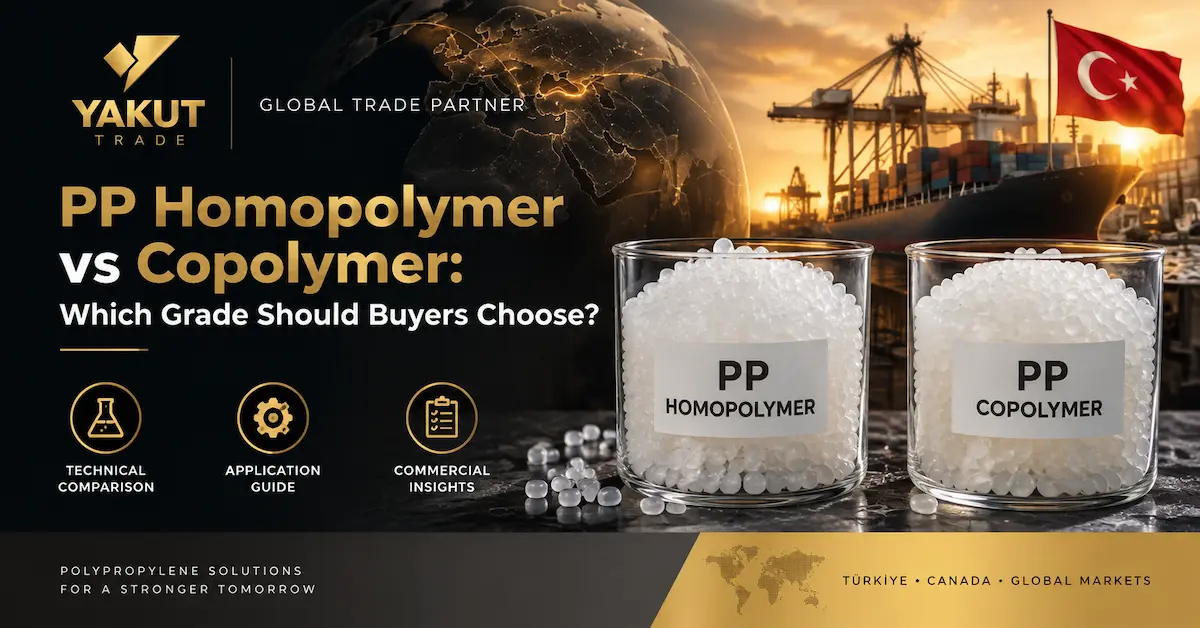
PP Homopolymer vs Copolymer: Which Grade Should Buyers Choose?
Choosing between polypropylene homopolymer and copolymer is an important technical decision for manufacturers and industrial buyers. The correct PP grade affects product performance, processing efficiency, durability and final application results.
Understanding the Difference Between PP Homopolymer and Copolymer
Polypropylene (PP) is one of the most widely used thermoplastic polymers in the world. It is used in packaging, automotive components, household products, fibers, industrial parts and many other applications.
When purchasing polypropylene resin, buyers often need to choose between PP Homopolymer and PP Copolymer. Although both materials are polypropylene-based, their molecular structure creates differences in stiffness, impact resistance, transparency and processing behavior.
The correct choice depends on the final product requirements, manufacturing process and required mechanical properties.
Buyers looking for polypropylene supply options can also review Yakut Trade’s polymer portfolio for available PE and PP grades.
What Is PP Homopolymer?
PP Homopolymer is a polypropylene grade produced using only propylene monomer. Because of its molecular structure, it generally provides higher stiffness, good strength and strong temperature resistance.
It is commonly selected for applications where rigidity and structural performance are important.
Key Characteristics of PP Homopolymer
- Higher stiffness compared with many copolymer grades
- Good tensile strength
- Higher heat resistance
- Good processing performance
- Suitable for rigid applications
Common Applications of PP Homopolymer
| Application | Why PP Homopolymer Is Used |
|---|---|
| Raffia & Woven Bags | High strength and stiffness requirements |
| Fibers | Suitable processing and mechanical performance |
| Rigid Packaging | Good structural properties |
| Industrial Components | Balance of strength and heat resistance |
What Is PP Copolymer?
PP Copolymer is produced by combining polypropylene with another monomer, commonly ethylene, to improve specific properties such as impact resistance and flexibility.
Compared with homopolymer, copolymer grades are often preferred for applications where toughness and resistance to impact are more important than maximum stiffness.
Key Characteristics of PP Copolymer
- Improved impact resistance
- Better toughness at lower temperatures
- Higher flexibility
- Good durability for demanding applications
- Suitable for products exposed to mechanical stress
PP Homopolymer vs PP Copolymer: Technical Comparison
The main difference between polypropylene homopolymer and copolymer comes from their molecular structure. This difference directly affects stiffness, impact resistance, flexibility and suitability for different applications.
| Property | PP Homopolymer | PP Copolymer |
|---|---|---|
| Stiffness | Higher rigidity and structural strength | Generally lower stiffness with improved toughness |
| Impact Resistance | Good, but lower than copolymer in demanding conditions | Improved impact resistance and durability |
| Flexibility | More rigid | More flexible |
| Temperature Performance | Excellent heat resistance | Better low-temperature impact performance |
| Transparency | Usually lower transparency | Certain copolymer grades provide improved clarity |
| Typical Use | Rigid products, fibers, raffia and structural applications | Automotive parts, containers and impact-resistant products |
PP Homopolymer vs Copolymer: Which One Should You Choose?
The correct polypropylene grade depends on the final product requirements. There is no single “best” PP grade for all applications.
Choose PP Homopolymer When:
- High stiffness is required
- The product needs structural strength
- Heat resistance is important
- The application requires rigid performance
Choose PP Copolymer When:
- Impact resistance is a priority
- The product experiences mechanical stress
- More flexibility is needed
- Low-temperature performance matters
Application-Based PP Grade Selection
Technical buyers usually select polypropylene based on the manufacturing process and final product performance rather than price alone.
| Application | Common Choice | Reason |
|---|---|---|
| Woven Bags & Raffia | PP Homopolymer | Strength, stiffness and processing performance |
| Automotive Components | PP Copolymer | Better impact resistance and durability |
| Food Containers | Homopolymer / Copolymer depending on requirement | Depends on stiffness, impact and clarity needs |
| Industrial Parts | Impact Copolymer | Improved toughness under stress |
| Fibers | PP Homopolymer | Good strength and processability |
Important Parameters Buyers Should Check Before Ordering PP
Before purchasing polypropylene, buyers should review technical data and ensure the selected grade matches their production requirements.
Melt Flow Index (MFI)
Determines flow behavior during processing and suitability for different manufacturing methods.
Impact Resistance
Important for products exposed to mechanical stress or sudden impact.
Density & Mechanical Properties
Affects product strength, weight and final performance.
Common Mistakes When Selecting PP Homopolymer or Copolymer
Choosing the wrong polypropylene grade can create production problems, increase costs and affect final product quality. Many purchasing decisions focus only on price, while technical suitability is equally important.
Selecting Based Only on Price
A lower-priced PP grade may not provide the required mechanical properties or processing performance.
Ignoring Application Requirements
The correct grade depends on the final product, production method and performance expectations.
Not Reviewing Technical Data
MFI, impact resistance and other technical properties should be checked before purchase.
Comparing Different Grades
PP Homopolymer and Copolymer offers should only be compared when specifications are equivalent.
How to Choose the Right Polypropylene Grade for Your Project
A professional polypropylene selection process should start with technical requirements and end with commercial evaluation.
01
Define Application
Identify the final product and required performance.
02
Select Processing Method
Injection molding, extrusion, fiber or film production.
03
Review Technical Data
Compare MFI, mechanical properties and specifications.
04
Evaluate Supplier
Confirm documentation, availability and commercial capability.
How Yakut Trade Supports Polypropylene Buyers
Choosing the correct polypropylene grade is only one part of a successful international polymer purchase. Buyers also need reliable sourcing support, supplier communication and commercial coordination.
Yakut Trade helps companies evaluate polypropylene sourcing opportunities by understanding technical requirements, identifying suitable supply options and supporting international trade procedures.
Grade Evaluation
Understanding buyer requirements and matching suitable PP specifications.
Supplier Coordination
Supporting communication with relevant commercial partners.
Transaction Support
Helping coordinate commercial steps and documentation.
Learn more about our
commodity sourcing and international trade services
.
Polypropylene Buyer RFQ Checklist
Before requesting a polypropylene quotation, technical buyers should provide enough information to allow suppliers to recommend the correct grade.
- Required PP type: Homopolymer or Copolymer
- Final product application
- Processing method
- Required MFI range
- Required quantity
- Destination country or port
- Preferred Incoterms (FOB/CFR/CIF)
- Delivery schedule
- Required technical documents
Frequently Asked Questions About PP Homopolymer vs Copolymer
Need Help Selecting the Right PP Grade?
Share your application, required specifications and quantity. Yakut Trade can help evaluate suitable polypropylene sourcing options.