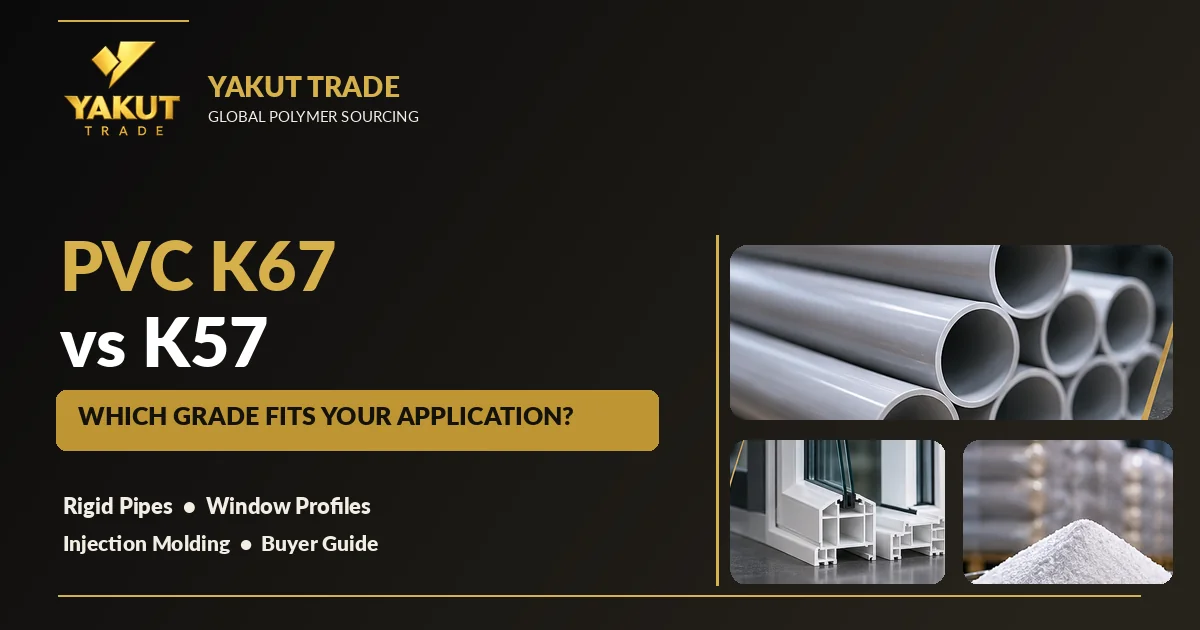
Choosing between PVC K67 vs K57 is a practical manufacturing decision for producers of rigid pipes, window profiles, injection-molded fittings and technical packaging. Both are suspension-polymerized PVC resin grades, but the different K-value ranges reflect different viscosity and molecular-mass characteristics that influence how a PVC compound behaves on the production line.
For international procurement managers, comparing only the resin price per metric ton can be costly. A grade that processes efficiently in pipe extrusion may not be the best match for a complex injection-molded fitting. Likewise, an easy-flow grade may not produce the mechanical performance required by a given pipe standard. The appropriate choice depends on the producer’s Technical Data Sheet (TDS), the complete formulation, machine capability and validation tests.
This guide explains how to interpret PVC K-value, identify typical applications, compare grade-specific documentation and prepare a complete RFQ before a bulk purchase.

PVC K67 vs K57: Which Resin Grade Fits Your Application?
Compare molecular characteristics, extrusion and injection processing, industrial uses and supplier documentation before requesting a commercial offer.
Quick Answer: K67 for Pipe Extrusion or K57 for Injection Molding?
Common Pipe & Profile Extrusion Choice
Usually considered for rigid PVC-U pipes, window profiles and conduits when the compound and extrusion line are engineered around a compatible K65–67 resin.
Often Considered for Rigid Injection
Frequently associated with easier-flowing formulations for selected molded fittings, rigid packaging and other applications where appropriate injection performance is required.
Qualification: These are typical starting points, not universal rules. A K57 resin is not automatically approved for every fitting, nor is K67 inherently suitable for every pressure pipe. Use producer-grade data and qualified plant trials.
1. What Does PVC K-Value Mean?
PVC K-value is a viscosity-based indicator associated with the average molecular mass of polyvinyl chloride. In practical procurement, higher K-values generally indicate higher molecular mass and different processing and mechanical-performance potential. The test method must be specified: the widely used ISO 1628-2 framework addresses determination of viscosity number and K-value of PVC resins.
K-value should not be confused with melt flow index (MFI) used for some other polymers. PVC is normally processed as a stabilized compound, and its thermal sensitivity makes direct application of a generic MFI comparison misleading. Differences in stabilizers, modifiers, lubricants, fillers and processing aids can substantially change production performance.
A grade commonly sold as “K67” may have an actual specification range such as 66–68, while another producer reports a nominal 67 with a tolerance. Similarly, a producer’s K57-associated grade may be specified around 57–59. The grade name is therefore only the beginning of the technical discussion.
What Higher and Lower K-Values Mean in Production
- Higher K-value (approximately K65–67): often used where the desired extrusion behavior and final formulation suit rigid pipes and profiles.
- Lower K-value (approximately K57–59): often associated with easier processing of selected rigid injection molding and blow-molded applications.
- Not a stand-alone quality score: high K-value does not automatically mean a better resin; the right number depends on the use case.
- Producer-specific testing: particle properties, porosity, bulk density, fusion, color and contamination remain important after a K-value shortlist.
2. PVC K67 vs K57: Side-by-Side Buyer Comparison
| Procurement criterion | PVC K67 | PVC K57 |
|---|---|---|
| Typical target K-value | Around 65–67 or producer-defined K67 range | Around 57–59 or producer-defined K57 range |
| Relative molecular-mass tendency | Higher | Lower |
| Common primary application | Rigid pipe, conduit and window/profile extrusion | Selected rigid injection-molded products and fittings; some rigid packaging processes |
| Processing priority | Adequate fusion, extrusion stability, mechanical performance | Flow, mold filling and cycle stability within a specified compound |
| Typical material handling | Suspension PVC resin: grade-specific powder/granules | Suspension PVC resin: grade-specific powder/granules |
| Critical validation | Pipe/profile compound qualification; extrusion run; relevant product standard | Molding trial, dimensions, weld lines, impact and assembly tests |
| Key commercial question | Can this exact grade meet our pipe/profile specifications? | Does the approved formulation mold consistently on our equipment? |
| Are the grades interchangeable? | Not without supplier and customer validation | Not without supplier and customer validation |
The general relationship between K-value and uses is supported by published technical material from producers such as China General Plastics Corporation (CGPC), which lists H-58 at K57–59 for injection/blow molding and H-66 at K65–67 with rigid pipe among its applications. These are examples of named manufacturer grades, not specifications for every resin sold as K57 or K67.
3. Where PVC K67 Is Commonly Used
Rigid PVC Pipe and Conduit Extrusion
K67 is a common starting point for rigid PVC-U pipe and conduit systems. A suitable resin can support a stable extrusion process when combined with the correct heat stabilizer, lubrication package, filler controls and processing aids. The resulting pipe must still comply with the required dimensional, pressure, impact and other performance standards of its destination market.
For example, Vinidex’s technical pipe material guide discusses typical PVC pipe formulations based on K67 resin. That context reinforces the industrial relevance of the grade, but does not make every K67 cargo universally pipe-approved.
Window Profiles, Building Profiles and Rigid Sheet
Profile extrusion also demands controlled fusion, dimensional stability, surface finish and long-term application performance. Resin characteristics interact with impact modifiers, processing aids, pigments and UV-stability systems. Buyers should obtain the resin manufacturer’s recommended application range and perform extrusion trials under representative conditions.
When K67 May Be a Poor Substitute
A molding plant using a validated lower-K compound should not replace it with K67 solely because a trader offers more favorable pricing. The substitution may change melt behavior, filling pressure, fusion characteristics, surface quality and reject rates. The finished part’s design and compound should determine approval.
4. Where PVC K57 Is Commonly Used
Injection-Molded Rigid Fittings and Components
Lower-K PVC grades are often considered for rigid injection molding because a comparatively lower molecular mass can improve processing behavior in suitable formulations. Pipe fittings, certain connectors and shaped parts may benefit where mold filling and dimensional consistency are critical.
However, a fitting can be designed for demanding working pressures or mechanical performance. The target product standard, resin compound and actual molding tests must establish whether a K57 grade is suitable. Do not assume that any K57 grade is adequate for pressure-rated fittings without independent qualification.
Blow-Molded and Selected Rigid Packaging Applications
Some producer ranges also position K57–59 resins for rigid bottle or container processes. This application depends heavily on processing technique, wall distribution and compound formulation; K57 is not automatically the universal bottle grade. Always distinguish PVC resin from the finished stabilized compound and evaluate destination-specific restrictions on end-use.
Why K57 Is Not the Default for Every Pipe
A lower-K resin chosen for easier molding is not a direct replacement for the higher-K materials typically selected for many rigid-pipe extrusion programs. A change may influence the mechanical performance of the finished compound, fusion window and other properties. Only approved technical evidence and representative trials can establish suitability.
5. Molecular Weight, Viscosity and Processing: The Real Trade-Off
Higher K-value PVC typically has higher molecular mass and different rheological behavior than lower-K resin. In a commercial factory, these differences interact with the amount and type of processing aid, heat stabilizer, lubricant, impact modifier and filler. A K-value cannot predict the actual melt pressure or output rate of a complete compound by itself.
A processor changing grade should examine the processing window, extrusion torque or injection pressure, material fusion behavior, visual defects, dimensional stability and the finished product’s qualification test results. The most economical grade is the one that consistently produces accepted units—not necessarily the resin with the lowest quoted USD/MT.
| Factory question | What to check | Why it matters |
|---|---|---|
| Will the material fuse consistently? | Fusion characteristics using the proposed compound | Reduces under-fusion, degradation and defects |
| Will output and cycle time change? | Extrusion rate or injection cycle under matched conditions | Affects acceptable throughput and unit economics |
| Will strength or impact results change? | Finished-product mechanical testing | Performance depends on resin and compound |
| Will the appearance stay acceptable? | Color stability, surface quality and gels | Relevant for profiles, packaging and visible parts |
| Are additives compatible? | Thermal stabilizers, lubricants, modifiers and fillers | A different formulation may be required |

6. Read the Producer TDS Before Comparing Offers
For PVC resin procurement, Technical Data Sheet (TDS) describes typical or specified material properties, while the Certificate of Analysis (COA) should be relevant to the actual lot or consignment and the agreed tests. A generic brochure cannot replace current cargo documentation.
| Parameter | How to evaluate it | Typical concern |
|---|---|---|
| K-value / viscosity | Exact value, acceptable range and cited method (e.g., ISO 1628-2) | Grade identity and technical shortlist |
| Apparent bulk density | Report value and test method (e.g., ISO 60) | Handling, feeding and blend consistency |
| Particle-size distribution / sieve | Relevant retained and passing fractions | Powder transport, gels and processing |
| Volatile matter | Specified limit and method (e.g., ISO 1269) | Moisture-related processing quality |
| Plasticizer absorption / porosity | Assess where relevant to the formulation | Fusion and compounding characteristics |
| Residual vinyl chloride monomer (VCM) | Relevant value, method and end-use requirements | Regulatory and safety qualification |
| Foreign particles and fish-eyes | Count or test criterion where material use requires it | Finished-product defects |
| Manufacturer and lot identification | Traceable grade, batch, packing and COA | Commercial and quality accountability |
Avoid using typical values from one producer as guaranteed acceptance limits for another producer’s grade. For example, CGPC lists separate H-58 and H-66 specifications, whereas other manufacturers publish different tolerance bands and measurement methods. In an RFQ, ask for the exact commercial grade code and the current revision of its TDS.
7. PVC Pipe Grade vs Injection Grade: Application Decision Matrix
| End application | Starting-point resin | Minimum approval needed |
|---|---|---|
| Rigid pressure pipe | Manufacturer-approved K65–67 or specified pipe grade | Pipe standard, formulation, hydrostatic and mechanical tests as applicable |
| Window and door profile | Approved extrusion K65–67 or exact specified profile grade | Surface/weathering/dimensional and processing validation |
| Rigid conduit | Approved rigid extrusion grade | Relevant conduit performance and compliance tests |
| Injection-molded rigid fitting | Approved injection-friendly grade, often lower K | Mold trial, weld-line, impact, pressure or other service tests |
| Rigid bottle or shaped container | Producer-recommended molding grade, possibly K57–59 | Process trial, wall distribution and end-use regulations |
| Flexible product or cable compound | Application-specific PVC grade and formulation | Do not infer from K57/K67 alone; evaluate full compound |
If you are still deciding between suspension resin and fine dispersion/paste resin, review the separate comparison Suspension PVC vs Emulsion PVC. That article covers polymerization route and plastisol applications; the current guide focuses specifically on comparing K67 and K57 within PVC grade selection.
8. How to Compare K67 and K57 Prices Without Losing Margin
A reliable grade comparison starts with equivalent producer documentation and finished-product acceptance. Price per metric ton does not capture potential line stoppages, lower output, rejected parts or changes in stabilizer demand. A technically inappropriate grade can create a higher effective cost even when the purchase price is lower.
For serious commercial evaluation, request current terms for the exact resin grade, origin, order volume, packaging, destination, shipment window and payment method. If two producer grades are technically approved, compare total landed cost and factory throughput rather than headline resin price alone.
No fixed price list: Yakut Trade does not treat indicative market discussions as a guaranteed selling price or a commitment to inventory. Use international sourcing services to review a real requirement and request current commercial terms.
9. How to Verify a PVC Resin Supplier Before a Bulk Order
Confirm that the counterparty can identify the resin producer, exact grade and legitimate route of supply. A trader or distributor may be a valid counterparty, but the buyer needs clarity about who produces the resin, who issues the COA and who is responsible for the commercial contract.
- Verify legal business identity, address and authorized contact.
- Match the producer grade, packing labels and COA lot numbers.
- Check actual origin and whether the shipment matches the technical offer.
- Confirm whether samples or an approved trial batch are available under agreed conditions.
- Review shipment quantity, delivery term, requested inspection and payment procedures.
- Investigate mismatches between the contracting company and bank account.
- Require written grade-approval procedures before changing an existing resin supplier.
For additional counterparty checks, Yakut Trade offers supplier verification support, subject to the agreed commercial scope. Such screening complements—not replaces—independent legal, laboratory, inspection or banking verification when necessary.
10. Packing, Shipping and Storage of PVC Resin
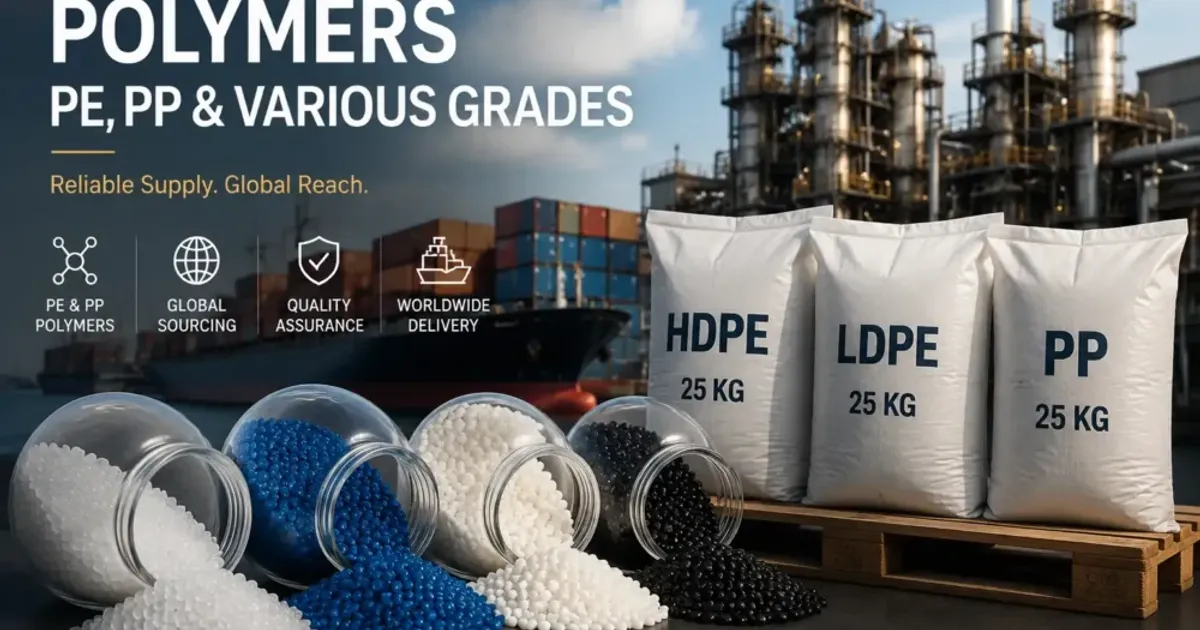
PVC suspension resin is commonly shipped as bagged powder in industrial supply chains. Depending on producer capability and commercial terms, formats may include 25 kg bags, larger bags or other approved bulk handling arrangements. The packaging format should be specified in the purchase contract; do not assume one package is available from every supplier.
Buyers should confirm the gross/net mass, number of bags, palletization or container-stuffing plan, moisture protection, label/lot traceability and destination unloading capability. Store resin in clean, dry conditions consistent with the producer’s SDS and packaging instructions, and avoid heat, moisture or contamination during storage.
FOB, CFR and CIF are relevant maritime terms where suitable, but FCA, CPT or CIP may be a more appropriate basis for containerized resin handed to a carrier before vessel loading. Define the named place and Incoterms 2020 rule clearly in the quotation.
11. PVC K67 / K57 Buyer RFQ Checklist
- Company registered name and website
- PVC producer and precise grade code
- Required K-value range and applicable method
- End product and processing equipment (extrusion, injection, etc.)
- TDS and COA parameters that must be met
- Approved alternative-grade policy and sample trial requirements
- Quantity per shipment and estimated annual demand
- Packing format and pallet requirements
- Destination country / port / named delivery place
- Requested Incoterm, shipment window and payment terms
- Applicable end-use and destination-market regulatory requirements
An RFQ that includes the actual processing application and target standard will usually generate a more useful technical proposal than a message asking for “best K67 or K57 price” without context.
Frequently Asked Questions
Is PVC K67 better than PVC K57?
Neither is universally better. K67 is commonly selected for rigid pipes and profiles, while some K57–59 grades are used for selected injection and rigid molding processes. Approval depends on exact producer grade, the full compound, equipment and product standard.
What is the main difference between PVC K67 and K57?
The main difference is the K-value, a viscosity-related indicator of PVC molecular characteristics. K67 typically denotes higher molecular mass than K57, which can affect processability and the properties of a qualified compound.
Is K67 PVC suitable for pipe extrusion?
Many K65–67 suspension PVC grades are designed for rigid pipe and profile extrusion, but the technical data sheet and the finished-pipe qualification requirements determine actual suitability.
Can K57 PVC be used for pipe fittings?
Some lower-K suspension PVC grades are offered for injection-molded fittings. Suitability for a particular pressure rating or structural application requires a fully validated compound and final-product testing.
Can K57 replace K67 to reduce cost?
Not automatically. Replacement may change processing, formulation requirements and finished performance. Approve a substitution only after technical review, trials and customer or engineering sign-off.
What documents should be requested from PVC resin suppliers?
Request an identifiable producer TDS, relevant batch COA, SDS, grade and lot identification, origin and trade documents, and regulatory evidence required by the intended end use and destination market.
Is PVC K-value the same as melt flow index?
No. PVC K-value is viscosity-based and related to molecular characteristics. It is not interchangeable with MFI figures commonly used to compare melt flow of other polymers.
Does Yakut Trade publish fixed PVC K67 or K57 prices?
No fixed selling price is represented by this guide. Buyers should send their grade, quantity, destination and payment terms to request current availability and commercial conditions.
Conclusion: Select PVC Resin by Application, Not by Label Alone
For many rigid PVC pipe and profile lines, a producer-approved K65–67 resin is a reasonable starting point. For selected injection-molded fittings and rigid components, a lower-K grade around K57–59 may be worth evaluating. But these broad associations are not a substitute for a producer-specific TDS, validated compound and finished-product acceptance tests.
The strongest international purchasing process combines the correct resin grade with traceable documentation, a qualified manufacturer or counterparty, suitable logistics and a clear RFQ. Use the Yakut Trade polymer sourcing portfolio to explore commercial channels while keeping technical selection and purchase terms explicit.
Request the Right PVC Resin Grade
Send your manufacturing application, producer grade or K-value, annual consumption, order quantity, destination and requested commercial terms. Yakut Trade can review commercially relevant sourcing opportunities without making a fixed stock or price commitment.
Direct enquiries: sales@yakuttrade.com
Technical References
CGPC — PVC Resin Grades and Applications | Vinidex — PVC Pipe Material Properties | Asia Petrochemicals — K67 Resin Technical Data | Indian Vinyl Council — Resin K-Value and Applications