
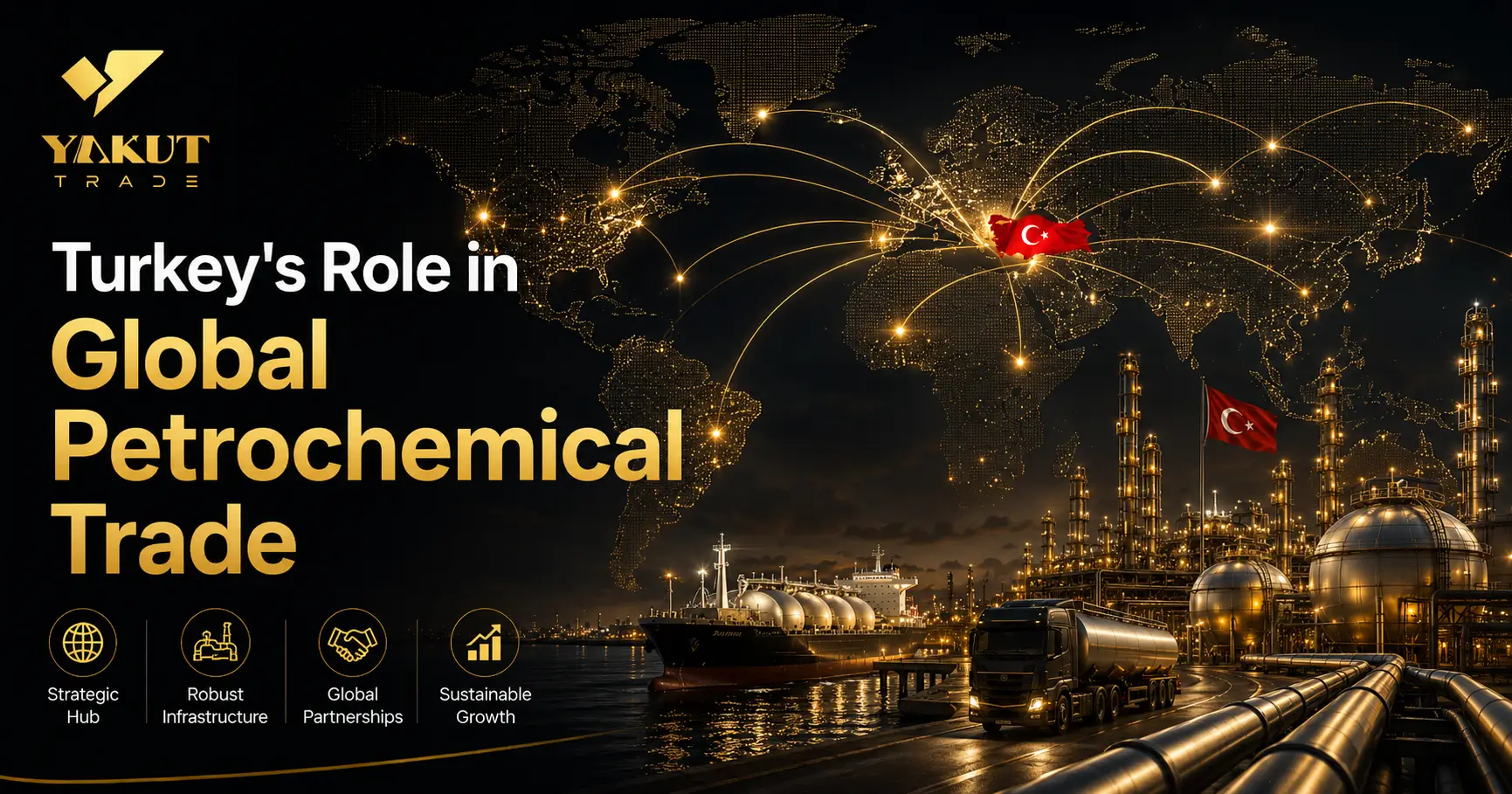
Turkey is no longer merely a consumer or transit point in the global energy and chemicals supply chain. In 2026, it is actively reshaping its position — becoming one of the most strategically important hubs for petrochemical production, petroleum product export, and commodity trade across Europe, the Middle East, and Asia.
For international buyers, commodity traders, and procurement professionals sourcing petroleum derivatives, polymers, or chemical raw materials, understanding Turkey’s industrial and logistical role in this landscape is now a commercial necessity. The decisions made in Istanbul boardrooms, at Ceyhan’s marine terminals, and inside Adana’s new industrial zones are influencing supply chains from London to Lahore.
This overview examines Turkey’s current and emerging position in global petrochemical trade, covering the country’s refining infrastructure, export geography, major investment pipeline, market challenges, and what it all means for B2B buyers and international traders who work with Turkish-origin product.
This Article Covers
- ◆Turkey’s petrochemical market size and growth trajectory through 2033
- ◆The refining infrastructure that makes Turkey a regional supply hub
- ◆Key pipeline and port assets: BTC, Kirkuk-Ceyhan, Mersin, Derince
- ◆The $25+ billion investment wave reshaping Turkish petrochemical capacity
- ◆Turkey’s export markets and where product flows in 2026
- ◆Challenges: currency pressure, polymer oversupply, and European demand slowdown
- ◆What all of this means for B2B buyers sourcing from Turkey
Turkey’s Petrochemical Market: A Snapshot in Numbers
The scale of Turkey’s petrochemical sector often surprises buyers who still think of the country primarily as a textile or agricultural exporter. The reality in 2026 is considerably more complex — and commercially significant.
Turkey’s petrochemical market reached USD 8.39 billion in 2024 and is projected to grow to USD 15.19 billion by 2033, representing a compound annual growth rate (CAGR) of 6.11%. That trajectory is not speculative — it is backed by committed capital already in construction or approved by presidential decree.
The chemical sector as a whole — which includes petrochemicals alongside cosmetics, pharmaceuticals, and industrial chemicals — generated USD 24 billion in exports in 2025 and is targeting USD 27 billion in 2026. Chemicals are currently the second-largest export category in Turkey’s economy, accounting for approximately 14% of total exports.
$8.4B
Petrochemical Market (2024)
Growing at 6.11% CAGR to 2033
$15.2B
Projected Market Size (2033)
Driven by domestic & export growth
$24B
Chemical Sector Exports (2025)
Targeting $27B in 2026
$42.8B
Chemical Imports (2024)
Massive import substitution opportunity
The contrast between the export figure and the import figure is the single most important data point for understanding Turkey’s industrial strategy in 2026. Turkey imported $42.8 billion worth of chemicals in 2024, of which organic chemicals and primary plastics alone accounted for over $20 billion. The gap between what Turkey currently produces and what it consumes domestically represents both the challenge and the commercial opportunity — and explains the extraordinary scale of investment now flowing into the sector.
Refining Infrastructure: Turkey’s Industrial Backbone
A country’s role in petrochemical trade is ultimately constrained by its refining capacity. Turkey’s refining infrastructure — dominated by two major entities — gives it a production base that few Eastern European or Middle Eastern peers can match on a per-capita basis.
Tüpraş: Turkey’s Petroleum Backbone
Türkiye Petrol Rafinerileri A.Ş. — universally known as Tüpraş — is the country’s primary refiner and one of the largest in Europe by throughput capacity. The company operates four refineries with a combined crude processing capacity of approximately 30 million tonnes per year:
| Refinery | Capacity & Notes |
|---|---|
| Izmit (Kocaeli) | 11 million tonnes/year — flagship facility near Istanbul; Mediterranean crude via tanker |
| Izmir (Aliağa) | 11 million tonnes/year — exports-focused; located alongside SOCAR STAR refinery |
| Kırıkkale | 5 million tonnes/year — inland facility; supplied via pipeline from Ceyhan Mediterranean terminal |
| Batman | 1.1 million tonnes/year — oldest Turkish refinery (est. 1955); proximity to domestic oil fields |
Tüpraş produces the full spectrum of refined petroleum products including EN590 diesel, Jet A1 aviation fuel, LPG, fuel oil, naphtha, and bitumen. In 2025, the company signed a five-year supply agreement to deliver 1.8 million tonnes of jet fuel annually to Istanbul Airport — a contract that underscores both its production scale and its position as an essential domestic energy infrastructure asset.
SOCAR STAR Refinery: The New Generation Facility
SOCAR’s STAR refinery, commissioned in October 2018 at Aliağa on Turkey’s Aegean coast, added a structurally different type of refining capacity to Turkey’s portfolio. With a processing capacity of 200,000 barrels per day (approximately 10–13 million tonnes per year, following optimization upgrades), STAR was specifically designed to process Azeri Light, Kirkuk, and Urals crude — feedstocks accessible through Turkey’s existing pipeline infrastructure.
STAR supplies the adjacent Petkim petrochemical complex with naphtha and other raw material feedstocks, creating an integrated production chain from crude oil to finished petrochemical products. The refinery also exports diesel and jet fuel directly to European and Mediterranean markets, and in 2025 committed to supplying 700,000 tonnes per year of Jet A1 to Istanbul Airport. Together, Tüpraş and STAR secured more than 2.5 million tonnes of annual domestic jet fuel supply for Istanbul Airport — the busiest hub in Europe by traffic volume in 2025.
Pipeline & Port Infrastructure: The Logistics Advantage
Turkey’s strategic value in the global energy market is as much about what passes through it as what is produced within it. The country controls some of the most critical energy infrastructure in the Eastern Hemisphere — and in 2026, that infrastructure is carrying more volume than at any point in its history.
The Baku-Tbilisi-Ceyhan (BTC) Pipeline
The BTC pipeline stretches 1,768 kilometres from the Sangachal terminal near Baku, Azerbaijan, through Georgia, to the Ceyhan marine terminal on Turkey’s Mediterranean coast. In 2025, the pipeline transported approximately 207 million barrels (27 million tonnes) of crude oil, loaded onto 283 tankers destined for European and global markets. Since becoming operational in 2006, BTC has carried a cumulative total of over 4.7 billion barrels — making it one of the most consequential energy infrastructure investments of the 21st century.
For commodity traders and buyers, BTC’s relevance extends beyond crude oil. The pipeline effectively anchors Turkey as the western terminus for Caspian energy — meaning that Azerbaijani and Central Asian petrochemical feedstocks can reach international buyers via Turkish ports with significantly shorter transit times than alternative routes.
The Kirkuk-Ceyhan Pipeline: A Revived Strategic Asset
After years of disruption, the Kirkuk-Ceyhan pipeline — connecting Iraq’s northern oil fields to the same Ceyhan marine terminal — was restarted in late September 2025, following a tripartite agreement between Iraq, the Kurdistan Regional Government, and international oil companies. The restart restored Iraq’s ability to export 230,000 barrels per day via Ceyhan, bypassing traditional Persian Gulf routes. Iraq is pursuing plans to increase this to 250,000 barrels per day, with longer-term ambitions to extend the pipeline southward to Basra’s fields — a proposal that Turkey’s Energy Minister has actively advocated.
The pipeline has a theoretical capacity of 1.5 million barrels per day — far above its current utilization — meaning that if fully reactivated, Ceyhan would become one of the world’s highest-volume crude export terminals, fundamentally reinforcing Turkey’s role as the Eastern Mediterranean’s primary energy hub.
Turkey’s Port Infrastructure
Turkey’s petrochemical and petroleum product exports flow through a network of major commercial ports, each serving distinct trade routes:
| Port | Location | Primary Trade Function |
|---|---|---|
| Mersin | South Coast (Med.) | Largest petroleum and bulk commodity terminal; primary route to Middle East, Africa, and Asia |
| Ceyhan | South Coast (Med.) | BTC and Kirkuk crude terminal; marine loading for tankers to Europe and global markets |
| Derince | Sea of Marmara | Petroleum product export to Black Sea, Eastern Europe, and Russia routes |
| Izmir (Aliağa) | Aegean Coast | Adjacent to Tüpraş and STAR refineries; petroleum product and chemical exports to W. Europe and Mediterranean |
| Samsun | Black Sea Coast | Key transit point for Black Sea-origin oil and energy corridor connections |
The Investment Wave: Transforming Turkey’s Petrochemical Capacity
The single most significant development in Turkish petrochemicals in 2025–2026 is the extraordinary scale of committed investment. Multiple projects — ranging from multi-billion dollar greenfield complexes to strategic capacity expansions — are simultaneously reshaping what Turkey can produce and export.
SASA Polyester: The $25 Billion Watershed
In August 2025, Turkish polyester and polymer manufacturer SASA Polyester Sanayi A.Ş. announced the largest single private industrial investment in Turkey’s history: a $25 billion integrated petrochemical complex in Yumurtalık, Adana — designated by presidential decree as the SASA Polyester Yumurtalık Special Industrial Zone.
The project, spanning 5.5 million square metres on the Mediterranean coast, will be built in three phases. Phase 1 alone includes:
- ▸A polypropylene production facility with 1.2 million tonnes per year capacity — addressing Turkey’s current 2.5 million tonne annual import dependency
- ▸A new refinery with an annual capacity of 13 million tonnes
- ▸An integrated deep-sea port to facilitate direct export from the site
- ▸Production of aromatic chemicals currently imported at an estimated $6–7 billion per year
Construction commenced in Q1–Q2 2026. When operational, SASA’s complex is projected to reduce Turkey’s chemical imports by $7 billion per year and create up to 10,000 construction jobs and 3,000 permanent positions. For international polymer and chemical buyers, the SASA complex represents a future supply source of significant scale at a Mediterranean location with competitive freight access to Europe, Africa, and the Middle East.
Bayegan Group: $1.9 Billion Polypropylene Plant
Announced in January 2024 and progressing through 2025–2026, Bayegan Group’s joint venture polypropylene plant in Hatay province is a more immediately relevant addition to Turkey’s supply base. With a designed capacity of 450,000 tonnes per year, the facility is expected to meet approximately 20% of Turkey’s domestic polypropylene demand upon completion, reducing import costs by an estimated $500 million annually.
SOCAR Petkim Ethylene Cracker Expansion
SOCAR’s Petkim petrochemical complex — already one of the largest integrated chemical producers in the Eastern Mediterranean — is evaluating a major expansion of its ethylene cracker capacity. In January 2026, SOCAR Turkey’s refining and petrochemicals head Kanan Mirzoyev stated publicly that doubling the ethylene plant’s capacity could achieve triple growth in the Turkish ethylene market. An investment decision was expected in 2026.
Ceyhan PDH-PP Project: Renewable-Powered Petrochemicals
A $2 billion joint venture between Rönesans Holding, Stolthaven Terminals, and Algeria’s Sonatrach is developing a propane dehydrogenation / polypropylene (PDH-PP) facility at Ceyhan, designed to produce 472,500 tonnes of polypropylene annually. The facility will be powered entirely by renewable energy — positioning it as a differentiator for buyers subject to carbon border adjustment mechanism (CBAM) compliance requirements. Projected to come online in 2026, it will integrate with Ceyhan’s existing terminal infrastructure, creating direct export access from the production site.
| Project | Investment | Output Capacity | Timeline |
|---|---|---|---|
| SASA Polyester (Adana) | $25 billion | PP 1.2Mt + 13Mt refinery | Construction 2026+ |
| Bayegan Group (Hatay) | $1.9 billion | Polypropylene 450,000t/yr | 2025–2027 |
| SOCAR Petkim (Izmir) | TBD | Ethylene expansion (2x) | Decision 2026 |
| Ceyhan PDH-PP (Ceyhan) | $2 billion | Polypropylene 472,500t/yr | 2026 |
Total committed: ~$29 billion+ in new petrochemical capacity under construction or approval
Where Turkish Petrochemical Products Flow: Export Markets
Understanding Turkey’s export geography is essential for buyers who want to position themselves within supply chains that pass through or originate in Turkey.
Europe: The Primary Market, Under Pressure
Europe remains Turkey’s largest export destination, absorbing approximately 42% of Turkey’s total exports under the advantages of the EU-Turkey Customs Union (zero tariffs on industrial products). For petrochemicals and polymer products, European buyers have traditionally represented the dominant demand pool for Turkish-origin material.
However, 2025–2026 presents a more complex picture. European polymer demand has been lethargic, with manufacturing PMIs in Germany, France, and Italy consistently below the expansion threshold. Turkish producers — particularly in the polymer segment — are facing pressure as their primary export market absorbs less volume, just as major capacity expansions come online. The mismatch between supply growth and European demand growth is one of the most discussed challenges in Turkey’s chemical industry in 2026.
Middle East: Growing Strategic Importance
The Middle East and North Africa (MENA) region has emerged as an increasingly important destination for Turkish petroleum and chemical exports. Several structural factors make this market attractive:
- ▸Turkey’s geographic proximity and port infrastructure offer competitive freight costs to Gulf, Levant, and North African buyers
- ▸The restart of the Kirkuk-Ceyhan pipeline has strengthened Turkish-Iraqi commercial relationships, creating bi-directional trade flow opportunities
- ▸Regional infrastructure build-out — particularly in Saudi Arabia, UAE, and Egypt — creates demand for industrial chemicals, polymers, and construction-related petrochemical products
- ▸In the wake of Hormuz disruptions in 2026, Turkey’s Ceyhan terminal emerged as a critical alternative routing point, with the IEA’s Fatih Birol explicitly citing Turkey’s advantage as an energy transit hub
Asia: A Contested Market
Asian markets — particularly India, Pakistan, Bangladesh, and Southeast Asia — represent a significant long-term opportunity for Turkish petrochemical exporters, but the competitive landscape is intensifying. Middle Eastern producers (Saudi Arabia, UAE, Kuwait) and Asian producers (China, South Korea) are expanding capacity aggressively, creating pricing pressure in the same markets Turkish exporters are targeting.
Turkey has responded with trade policy tools: in 2025, Turkish authorities opened antidumping investigations into PTA and PET imports from Asia, signaling a more assertive posture in protecting domestic producers from subsidized competition. This pattern mirrors the EU’s approach to trade remedies and positions Turkey as an increasingly sophisticated trade actor.
Key Export Product Categories
| Product Category | Primary Export Destinations & Notes |
|---|---|
| EN590 Diesel (10 PPM) | North Africa, West Africa, Mediterranean — via Ceyhan and Mersin ports |
| Jet A1 Aviation Fuel | Istanbul Airport (domestic); growing Mediterranean export via STAR refinery |
| Bitumen | Middle East construction markets; Africa infrastructure projects |
| Polypropylene | Europe (primary), Middle East, North Africa — major growth expected post-SASA/PDH-PP |
| Polyester / PET | US, Europe, Middle East — SASA’s core historical export product |
| Naphtha | Petrochemical feedstock for European cracker operators |
| LPG | Domestic market dominant; regional exports to Bulgaria, Romania, Balkans |
| Sulphur | Agricultural fertilizer markets in India, Southeast Asia, MENA |
| Urea / Fertilizers | Middle East, North Africa agricultural buyers via Mersin port |
Market Challenges: A Balanced Assessment
Any credible overview of Turkey’s role in global petrochemical trade must also acknowledge the headwinds. Buyers and traders making sourcing decisions based on Turkey need to understand both the opportunity and the risk landscape.
Currency Volatility and Converter Margin Pressure
Turkish lira depreciation and elevated domestic interest rates have compressed the margins of downstream polymer converters throughout 2024–2025. While a weaker lira benefits exporters by making Turkish-origin product cheaper in dollar terms, it simultaneously increases the cost of imported raw materials — which Turkey still depends on heavily. The result is a squeeze on converter economics that can affect supply reliability and product pricing for B2B buyers working with Turkish processors.
Polymer Oversupply Concerns Through 2030
The same capacity expansion investments that create long-term supply opportunities also pose a near-term risk: potential oversupply in polymer markets. Middle Eastern producers are simultaneously adding significant polyethylene and polypropylene capacity, while Chinese producers have expanded aggressively. Turkey’s new capacity — most of which is targeting polypropylene — will enter a market where pricing may be under pressure, particularly if European demand recovery remains slow.
Capacity Utilization Softness
Turkey’s overall manufacturing capacity utilization declined to 73.3% in March 2026, its lowest level since August 2020. While this partly reflects temporary economic cycle factors, it is a metric that B2B buyers should track — lower capacity utilization in intermediate goods manufacturing (which fell to 74.7%) can affect the consistency and availability of chemical feedstocks.
Geopolitical and Regulatory Complexity
Turkey’s position at the intersection of multiple geopolitical fault lines — EU accession status, Russia-Ukraine conflict proximity, Iran-related sanctions exposure, Kurdish regional dynamics affecting Kirkuk-Ceyhan operations — creates a regulatory complexity that buyers must navigate carefully. Due diligence on sanctions compliance, counterparty ownership structures, and commodity origin documentation is essential for any large-volume transaction involving Turkish-intermediated product.
⚠️ Risk Management Note for International Buyers
When sourcing through Turkey-based intermediaries, buyers should:
- ✓Verify that the trading company has clear beneficial ownership disclosure (no opaque offshore structures)
- ✓Confirm commodity origin documentation does not expose buyers to third-country sanctions risk
- ✓Use LC or SBLC payment structures on all first-time or large-volume transactions
- ✓Request pre-shipment inspection by SGS, Bureau Veritas, or Intertek on every cargo
- ✓Work with Istanbul-based traders who have verifiable refinery relationships and documented export history
What This Means for B2B Buyers in 2026
The convergence of Turkey’s existing refining infrastructure, its pipeline and port geography, and the $29+ billion investment wave currently underway positions the country to significantly increase its share of global petrochemical trade through the end of the decade. For international buyers, this trajectory creates several concrete commercial implications:
Source diversification from Turkey is now viable at scale
With Tüpraş, SOCAR STAR, Petkim, and new greenfield complexes all operational or coming online, buyers can establish meaningful supply allocations from Turkey-origin product across diesel, polymers, fertilizers, and chemical intermediates.
Ceyhan is evolving from a crude terminal into a refined product hub
The Ceyhan PDH-PP project, combined with the pipeline restart and potential Basra extension, means Ceyhan will increasingly handle not just crude but finished petrochemical products — giving buyers direct access to Mediterranean-loaded cargo for multiple destinations.
Working with a qualified Istanbul-based broker creates access and efficiency
The complexity of navigating multiple refineries, inspection agencies, logistics providers, and regulatory requirements makes local expertise commercially valuable. A broker with established refinery relationships, documented export history, and experience in LC-based transactions reduces transaction risk and timeline.
Polypropylene sourcing from Turkey will grow materially post-2027
Buyers currently sourcing PP from Gulf or Asian producers should evaluate Turkey as a future secondary source — particularly given CBAM compliance considerations for European buyers, where Turkish renewable-powered production (the Ceyhan PDH-PP facility) may carry a differential advantage.
Monitor the Hormuz situation and its Turkey implications
Ongoing disruptions to Strait of Hormuz traffic in 2026 have heightened Turkey’s importance as an alternative energy transit corridor. Buyers with Middle Eastern supply relationships should actively track Turkey-routed alternatives through Ceyhan — this is a live market dynamic, not a theoretical contingency.
Frequently Asked Questions
Source Petrochemical Products from Turkey Through Yakut Trade
Yakut Trade Inc. is an Istanbul-based B2B commodity trading and sourcing company with direct relationships across Turkey’s petroleum and petrochemical supply chain — from Tüpraş-certified product to CIS-origin material loaded at Ceyhan. Our trading desk handles EN590 diesel, Jet A1 fuel, bitumen, sulphur, urea, and chemical raw materials, with logistics and documentation expertise across FOB, CIF, and DAP delivery structures.
Whether you are sourcing a trial cargo to qualify a Turkish-origin supply relationship, or evaluating long-term contract structures for volume commodity procurement, we can structure transactions that match your timeline, volume, payment requirements, and compliance framework.
Contact the Yakut Trade Commodity Trading Desk
Tell us the product(s), quantity, delivery port, and Incoterms preference — we respond to qualified inquiries within 24 hours.
Sources & References
- IMARC Group — “Turkey Petrochemicals Market Report 2033.” Market size and CAGR data.
- Toko Trading — “Turkey’s 2026 Export Potential.” Chemical sector export figures (Feb 2026).
- S&P Global Commodity Insights — “Turkey’s Polymer Market 2026” (Feb 2026).
- SASA Polyester Sanayi A.Ş. / Anadolu Agency — $25B Adana investment announcement (Aug 2025).
- Türkiye Today — “SASA Unveils $25B Petrochemical Project” (Aug 2025).
- BP Azerbaijan — BTC Pipeline 2025 Annual Operations Data. 207 million barrels, 283 tankers.
- AInvest / Discovery Alert — “Turkey’s Ceyhan as Strategic Energy Nexus” (Sep 2025).
- Türkiye Today — “Turkey Gains Hormuz Bypass Advantage via BTC” (Apr 2026).
- Hydrocarbon Processing — SOCAR STAR Refinery Jet Fuel Supply Agreement (Jan 2025).
- TRT World — “Turkey Ensures Energy Surplus: Tüpraş and STAR Jet Fuel Supply” (Jun 2026).
- Wikipedia / Interfax — Tüpraş and SOCAR STAR Refinery capacity data.
- Trading Economics — Turkey Capacity Utilization, 73.3% (March 2026).
- IndexBox — “Hormuz Shipping Crisis and Ceyhan Pipeline Restart” (2026).
About the Author
Yakut Trade Research Team | International Commodity Trading & Market Intelligence
Yakut Trade Inc. is a B2B commodity trading and international sourcing company headquartered in Istanbul, Turkey. Our market research series covers global trade trends, commodity supply chains, and procurement intelligence for B2B buyers across the Middle East, Europe, Africa, and Asia. This article is part of our Global Commodity Trade Series.
Related: What Is EN590 Diesel? | Our Petroleum Products | Contact Our Trading Team