
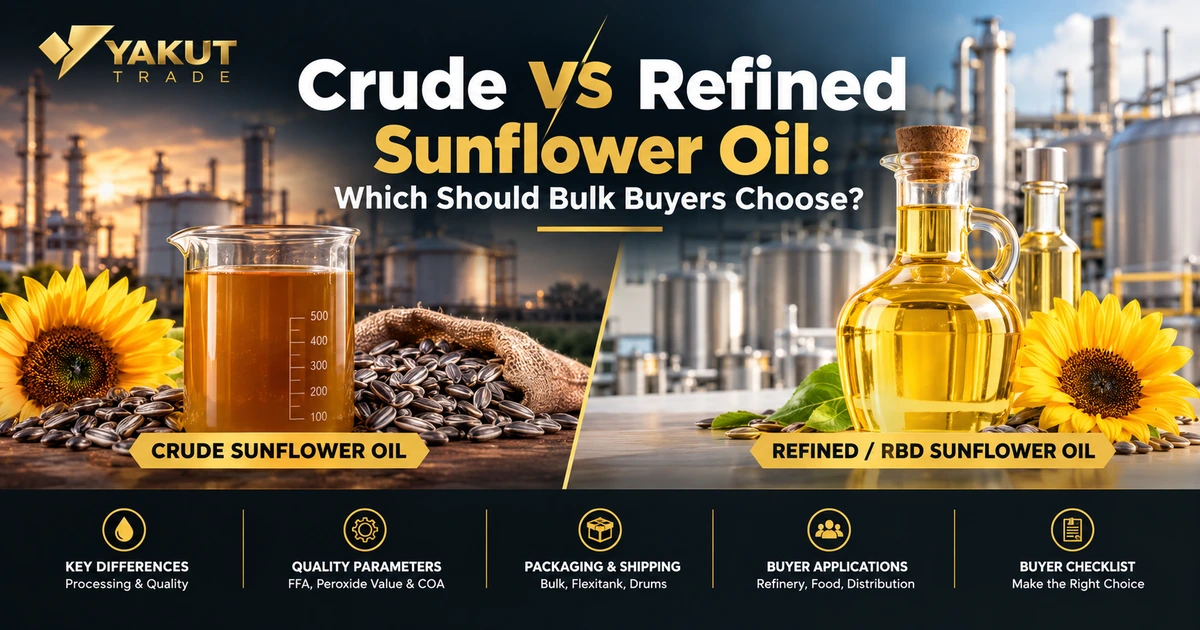
Crude vs Refined Sunflower Oil: Which Should Bulk Buyers Choose?
Choosing between crude and refined sunflower oil is an important procurement decision for oil refineries, food manufacturers, distributors and international importers. The right product depends on processing capability, intended use, quality specifications and total delivered cost.
The main difference between crude vs refined sunflower oil is that crude oil requires further treatment before most finished edible-oil uses, while properly refined oil is processed to meet the requirements of downstream food manufacturing, bottling or distribution.
For bulk buyers, the most important question is not simply which product is cheaper. It is which oil can be used economically and reliably within the buyer’s production or distribution system.
Quick Answer: Crude or Refined Sunflower Oil?
Choose Crude Sunflower Oil
If your facility has the equipment to degum, deacidify, bleach, deodorize and, where required, dewax the oil, crude sunflower oil may provide a commercially suitable feedstock.
Choose Refined / RBD Sunflower Oil
If you require oil for direct food manufacturing, bottling, food-service distribution or retail supply without further refining, appropriately specified refined oil is generally the more practical option.
Crude vs Refined Sunflower Oil: Main Differences
The following comparison summarizes the characteristics that matter most to industrial and commercial buyers.
| Factor | Crude Sunflower Oil | Refined / RBD Sunflower Oil |
|---|---|---|
| Processing | Not fully refined | Refined, bleached and deodorized |
| Primary Buyer | Oil refinery / industrial processor | Food manufacturer / distributor / bottler |
| FFA | Generally higher; varies by feedstock and quality | Reduced by refining |
| Colour | Usually darker or more variable | Typically lighter and more consistent |
| Taste & Odour | More characteristic of the crude oil | Generally neutral |
| Gums & Other Impurities | May require removal | Substantially reduced through processing |
| Further Processing | Normally required for conventional edible-oil supply | Generally not required if the finished specification is met |
| Price Evaluation | Include refining costs, losses and yield | Include finished quality, packaging and delivery costs |
What Is Crude Sunflower Oil?
Crude sunflower oil is oil obtained from sunflower seeds through mechanical pressing, solvent extraction or a combination of processing methods, before complete edible-oil refining.
Crude oil may contain varying levels of free fatty acids, phospholipids, natural pigments, waxes, moisture and other materials that must be managed during refining.
Its precise characteristics depend on seed quality, storage, extraction conditions and the handling of the oil before shipment.
Who Typically Buys Crude Sunflower Oil?
- Vegetable oil refineries
- Integrated edible-oil processing plants
- Industrial buyers with suitable purification capabilities
- Refiners producing bottled edible oils for domestic or export markets
- Selected industrial processors, subject to end-use specifications
For these buyers, crude oil can be economically attractive because the refinery performs the remaining treatment stages.
However, a lower crude-oil purchase price does not necessarily produce a lower finished-oil cost. The refinery must account for processing expenses, material losses, energy consumption and achievable yield.
What Is Refined or RBD Sunflower Oil?
RBD stands for Refined, Bleached and Deodorized. This processing sequence removes or reduces components that can affect colour, taste, odour, acidity and product stability.
Refined sunflower oil is widely used by companies requiring an oil that can enter food manufacturing or distribution without full-scale refinery treatment.
Typical buyers include food producers, wholesalers, bottlers, food-service businesses and international distributors.
Understanding the Refining Process
01
Degumming
Reduces phospholipids and gums.
02
Deacidification
Reduces free fatty acids through chemical or physical processing.
03
Bleaching
Reduces pigments, trace contaminants and certain oxidation products.
04
Deodorization
Removes undesirable volatile compounds responsible for odours and flavours.
Depending on the refinery process, wax removal and other treatments may also be required. The sequence can vary between chemical and physical refining systems.
RBD vs RBDW Sunflower Oil: Why Winterization Matters
Some commercial offers specify RBD sunflower oil, while others refer to RBDW, meaning Refined, Bleached, Deodorized and Winterized.
Sunflower oil naturally contains waxes that may cause visible cloudiness when the product is stored at relatively low temperatures. Winterization or dewaxing reduces these waxes and helps improve clarity under specified storage conditions.
This can be particularly relevant for bottled oil distributed through warehouses, supermarkets and markets where product appearance is important.
Important for Bottlers and Distributors
If cold clarity matters for your market, request a defined cold-test requirement and confirm whether the quoted refined sunflower oil has been adequately dewaxed. RBD does not automatically guarantee a particular cold-test performance.
Key Quality Specifications: What Bulk Buyers Should Check
Technical specifications should determine whether a sunflower oil shipment is suitable for its intended use. Buyers should request actual laboratory results rather than relying on descriptions such as “premium quality” or “high purity.”
| Parameter | Why It Matters | Buyer Consideration |
|---|---|---|
| FFA / Acid Value | Indicates free fatty acid content and refining requirements. | Critical for crude refining economics and refined quality. |
| Peroxide Value | Measures primary oxidation products. | Useful for assessing oil condition and oxidation risk. |
| Moisture & Volatiles | Indicates water and volatile matter. | Affects storage and processing. |
| Insoluble Impurities | Shows the presence of suspended insoluble materials. | Relevant to crude purification and finished-oil acceptance. |
| Phosphorus / Gums | Relates to phospholipid content and degumming needs. | Especially important for crude buyers. |
| Wax Content / Cold Test | Indicates potential haze and low-temperature clarity. | Important for bottled refined oil. |
| Fatty Acid Profile | Identifies composition and sunflower oil type. | Essential for conventional vs high-oleic specifications. |
| Colour / Odour | Indicates sensory and appearance characteristics. | Relevant to food manufacturing and consumer presentation. |
FFA in Crude vs Refined Sunflower Oil
Free Fatty Acids (FFA) are among the most important quality parameters in crude sunflower oil purchasing.
Higher FFA levels may increase processing requirements and influence the amount of usable finished oil obtained after refining. A refinery therefore needs to understand both the actual FFA content and the technical capacity of its equipment.
For refined sunflower oil, low acidity is an important indicator that the deacidification process has been effective.
FFA is often expressed as a percentage calculated as oleic acid, while Acid Value is expressed in mg KOH/g oil. These are related but different reporting formats, so buyers should specify the unit and test method in the contract.
Why Peroxide Value Is Important
Peroxide Value (PV) is used to assess primary oxidation products in vegetable oils. It is especially relevant when oil has been stored or transported for extended periods or exposed to unsuitable conditions.
A high peroxide value may indicate oxidation that deserves further investigation. However, PV alone does not provide a complete picture of oil deterioration, because peroxide compounds can decompose as oxidation progresses.
Commercial buyers should evaluate peroxide value together with acidity, sensory characteristics, storage history and other appropriate quality parameters.
Reference Quality Limits for Refined Vegetable Oil
The Codex Standard for Named Vegetable Oils includes reference quality characteristics for refined vegetable oils in its appendix.
These are general Codex reference values for refined vegetable oils, not confirmed specifications of a particular Yakut Trade cargo. The appendix identifies its quality characteristics as voluntary guidance for commercial partners. Buyers may require stricter contractual limits, and destination-country regulations must also be satisfied.
Technical reference: Codex Standard for Named Vegetable Oils.
Which Sunflower Oil Should Different Bulk Buyers Choose?
The buyer’s business model and available processing infrastructure usually determine the most suitable product.
| Buyer Type | Likely Choice | Reason |
|---|---|---|
| Vegetable Oil Refinery | Crude | Uses existing refining capacity to produce finished oil. |
| Food Manufacturer | Refined / RBD | Needs specified edible oil for food-processing operations. |
| Wholesale Distributor | Refined / RBD | Typically supplies food-service or retail customers. |
| Private-Label Bottler | Refined / RBDW | Requires appropriate finished quality and often cold clarity. |
| Industrial Processor | Application-dependent | Depends on processing equipment and end-use requirements. |
Do Not Confuse Refining Level With High-Oleic Sunflower Oil
Crude versus refined describes the processing condition of the oil. Conventional versus high-oleic sunflower oil describes its fatty acid composition.
A high-oleic product can also be crude or refined. Buyers requiring a particular fatty acid profile must specify it separately.
This distinction matters for food producers evaluating frying performance, oxidative stability and formulation requirements.
Crude vs Refined Sunflower Oil Price: What Should Buyers Compare?
Crude sunflower oil is commonly evaluated as a refining feedstock, while refined oil includes the value of additional processing. However, the price difference varies with market conditions, oil origin, quality, availability and commercial terms.
For a refinery, the lowest crude oil price is not automatically the best offer. High FFA, increased impurities, processing losses and additional treatment can increase the final cost of producing refined oil.
Compare Cost per Tonne of Usable Finished Oil
For buyers with refining capacity, a practical evaluation should consider:
Finished-Oil Cost per MT = (Delivered Crude Cost + Refining Costs + Other Relevant Costs) ÷ Saleable Refined-Oil Yield
Refining losses, by-product credits and operational expenses should be included according to the refinery’s actual cost model. This is a simplified comparison framework, not a universal production formula.
For food manufacturers and distributors, refined oil should be compared on the same quality specification, delivery basis, packing configuration and shipment schedule.
Yakut Trade can review product requirements and commercially relevant sourcing opportunities through its commodity sourcing and international trade services.
Packaging and International Shipping Considerations
The packaging and shipping configuration should match the product, order quantity, receiving infrastructure and food-safety requirements.
Depending on the supplier and destination, sunflower oil may be transported in bulk liquid systems, food-grade tank containers, flexitanks, industrial containers, drums or consumer packaging.
Bulk Liquid Shipment
May be appropriate for large-volume refinery or industrial buyers with suitable unloading and storage facilities.
Flexitank / Tank Container
Can be considered for compatible liquid cargoes, subject to carrier approval, food-grade suitability and destination handling capabilities.
Drums / Industrial Containers
May suit smaller industrial orders or buyers requiring more flexible handling and distribution.
Food-contact suitability, previous cargo history where relevant, tank cleanliness, seals, loading records and temperature exposure should all be considered.
Documents to Request Before Buying Sunflower Oil
A complete sunflower oil quotation should be supported by technical and commercial documents appropriate to the proposed transaction.
Certificate of Analysis (COA)
Actual quality test results linked to the applicable batch or cargo.
Product Specification
Agreed quality limits, units, test methods and oil type.
Certificate of Origin
Origin documentation where required by the importing country or contract.
Commercial Documents
Invoice, packing or weight list, transport document and insurance where applicable.
Depending on destination rules, buyers may also need additional food-safety, traceability, residue testing or regulatory documentation.
Quality Inspection and COA Verification Before Shipment
A reliable Certificate of Analysis is useful, but buyers should also establish how product sampling and quality acceptance will be managed.
For larger or higher-risk transactions, parties may agree on independent third-party sampling, testing or loading supervision.
Pre-Shipment Quality Checklist
- Confirm the exact oil type and product specification.
- Review the COA and its sampling date.
- Verify FFA / Acid Value and Peroxide Value using agreed methods.
- Check moisture, insoluble impurities and relevant additional parameters.
- Confirm cleanliness and suitability of the loading system.
- Agree on sampling, retained samples and dispute procedures.
- Check loading quantity and shipping documentation.
For buyers seeking additional counterparty review, Yakut Trade offers supplier verification services to support commercial due diligence before significant commitments.
FOB, CFR and CIF: Comparing Sunflower Oil Offers
Two quotations cannot be compared accurately unless the delivery basis is understood.
| Incoterm | Commercial Meaning | Buyer Check |
|---|---|---|
| FOB | Seller delivers the cargo on board the vessel at the named loading port. | Freight, insurance and destination expenses. |
| CFR | Seller pays carriage to the named destination port, while risk transfers on board at origin. | Insurance and destination costs. |
| CIF | Seller pays freight and contractually required cargo insurance to the named destination port; risk transfers on board at origin. | Insurance coverage, import costs and local fees. |
These maritime terms are especially relevant to traditional bulk vessel shipments. For containerized or multimodal transactions, the parties should also consider whether FCA, CPT or CIP is the more appropriate rule under Incoterms 2020.
Common Mistakes When Buying Crude or Refined Sunflower Oil
Choosing by Price Alone
Ignoring the additional refining costs or differences in finished-oil quality.
Requesting a Generic Grade
Using “sunflower oil” without defining crude, refined, winterized or fatty acid profile.
Skipping COA Review
Accepting a certificate without checking test results, date, sample identity and contractual limits.
Ignoring Storage Requirements
Overlooking contamination, oxidation, tank suitability or exposure during transportation.
How to Choose the Right Sunflower Oil: 5 Buyer Decisions
01
Define End Use
Refining, manufacturing, bottling or distribution.
02
Confirm Oil Type
Crude, RBD, RBDW or special fatty acid profile.
03
Check Specification
FFA, PV, moisture, impurities and other requirements.
04
Review Logistics
Volume, packing, destination and Incoterm.
05
Compare Suppliers
Quality evidence, commercial terms and delivery feasibility.
Sunflower Oil Buyer RFQ Checklist
Before contacting a supplier, prepare the following information to obtain a more relevant commercial quotation.
✓ Product Type
✓ Company Name
✓ Product Application
✓ Technical Specification
✓ Quantity
✓ Packaging
✓ Destination
✓ Incoterm
✓ Shipment Schedule
✓ Payment Terms
How Yakut Trade Supports Sunflower Oil Buyers
Yakut Trade works with international commodity buyers and commercial partners seeking sunflower oil sourcing opportunities across global markets.
For a crude or refined sunflower oil requirement, our sourcing and trading approach begins with understanding the buyer’s intended use, product specification, quantity, destination and commercial conditions.
01
Requirement Review
Confirm crude or refined type, specifications, volume and destination.
02
Supplier Search
Evaluate relevant sourcing opportunities based on requirements.
03
Commercial Review
Review documentation, delivery conditions and quotation details.
04
Trade Coordination
Support communication and agreed commercial transaction stages.
Explore our sunflower oil supply solutions or learn more about commodity sourcing services.