
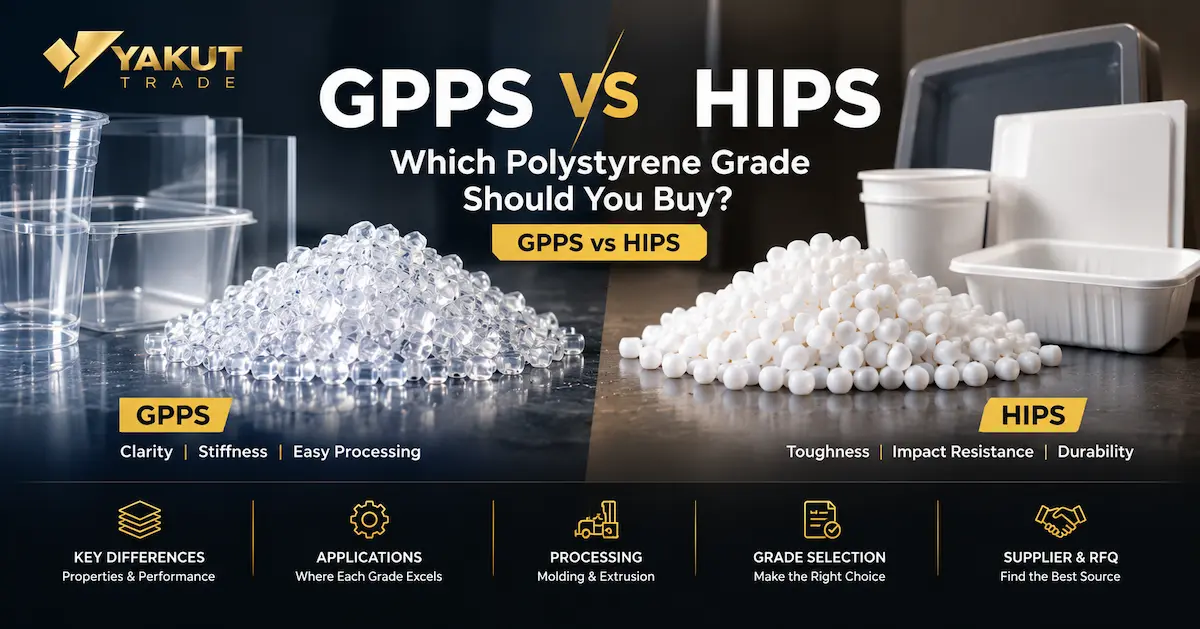
GPPS vs HIPS: Which Polystyrene Grade Should You Buy?
GPPS and HIPS belong to the polystyrene family, but they serve different manufacturing requirements. GPPS is commonly selected for clarity and stiffness, while HIPS is designed to provide greater toughness and impact resistance. Choosing the right material requires comparing the final application, processing method and required mechanical properties.
However, buyers should not treat all polystyrene grades as interchangeable.
Two of the most commonly discussed categories are:
GPPS
General Purpose Polystyrene
A rigid and typically transparent polystyrene used where clarity, stiffness and surface appearance are important.
HIPS
High Impact Polystyrene
A modified polystyrene designed to provide greater toughness and impact resistance for more demanding applications.
The correct choice depends on whether the buyer prioritizes transparency and rigidity or impact resistance and durability.
GPPS vs HIPS: Quick Comparison
| Property | GPPS | HIPS |
|---|---|---|
| Transparency | Usually high | Usually opaque |
| Stiffness | Higher | Generally lower |
| Impact Resistance | Lower | Higher |
| Surface Appearance | Clear, glossy | Glossy to matte depending on grade |
| Typical Priority | Clarity and rigidity | Toughness and durability |
| Common Processing | Injection molding, extrusion, thermoforming | Injection molding, extrusion, thermoforming |
What Is GPPS?
GPPS stands for General Purpose Polystyrene. It is often referred to as crystal polystyrene because many GPPS grades provide high transparency and a clear appearance.
GPPS is typically selected where manufacturers require rigidity, dimensional stability, attractive surface finish and ease of processing.
Typical GPPS Characteristics
- High transparency
- High stiffness
- Good dimensional stability
- Good surface gloss
- Easy processing
- Relatively low impact resistance compared with HIPS
Common GPPS Applications
Transparent Packaging
Useful where product visibility is important.
Disposable Products
Cups, containers and rigid single-use articles depending on grade.
Household Products
Rigid molded products where clarity or stiffness is required.
Laboratory Products
Selected clear molded products where the specific grade is approved.
What Is HIPS?
HIPS stands for High Impact Polystyrene. It is produced by modifying polystyrene to improve toughness and resistance to impact.
This modification changes the visual and mechanical properties of the material. HIPS is normally less transparent than GPPS, but it can withstand substantially greater mechanical impact.
Typical HIPS Characteristics
- Higher impact resistance
- Improved toughness
- Good processability
- Good dimensional stability
- Available in different surface finishes
- Generally opaque rather than crystal clear
Common HIPS Applications
Refrigerator Liners
HIPS is widely associated with thermoformed appliance components.
Food Packaging
Selected food trays and packaging products where approved grades are used.
Household Products
Applications requiring greater resistance to accidental impact.
Industrial Components
Various molded and thermoformed articles requiring greater toughness.
Why Is HIPS More Impact Resistant?
The key difference is material modification.
GPPS is a rigid polystyrene matrix with excellent clarity but relatively brittle behavior under impact.
HIPS contains an impact-modifying rubber phase that helps the material absorb more energy before failure. This improves toughness but reduces the crystal-clear transparency associated with GPPS.
Simple Buyer Rule:
If transparency is essential, GPPS usually deserves consideration first. If resistance to impact is more important, HIPS is generally the stronger candidate.
GPPS vs HIPS: Stiffness and Mechanical Performance
GPPS usually provides greater stiffness than HIPS.
This can be seen in commercial product ranges. Polystyrene producer data commonly show higher flexural modulus values for crystal GPPS grades than many impact HIPS grades.
However, higher stiffness is not automatically better.
Choose for Stiffness
GPPS may be appropriate when rigidity, dimensional stability and clear appearance are the main performance criteria.
Choose for Toughness
HIPS may provide better performance when parts are likely to experience handling, knocks or mechanical impact.
Transparency: One of the Most Important Selection Factors
Transparency is one of GPPS’s strongest commercial advantages.
Clear GPPS can be useful for packaging, display products, laboratory items and other applications where visibility or optical appearance matters.
HIPS sacrifices much of this transparency in exchange for impact performance.
| Requirement | Likely Starting Point |
|---|---|
| Crystal clarity | GPPS |
| Maximum toughness | HIPS |
| Rigid clear article | GPPS |
| Opaque impact-resistant component | HIPS |
Processing: Can GPPS and HIPS Use the Same Equipment?
Both materials can be processed using common thermoplastic manufacturing methods such as injection molding, extrusion and thermoforming, depending on the specific grade.
However, buyers should not assume that an existing GPPS grade can be replaced with HIPS without production adjustments.
Important parameters include:
- Melt Flow Index (MFI)
- Processing temperature
- Mold geometry
- Wall thickness
- Extrusion conditions
- Required cycle time
- Final product performance
Why Melt Flow Index Matters
Within both GPPS and HIPS families, different commercial grades may have very different melt-flow characteristics.
A high-flow grade may be preferred for certain injection-molded parts, while extrusion or thermoforming applications may require different melt-strength and flow behavior.
For this reason, an RFQ stating only “GPPS” or “HIPS” is incomplete for many industrial purchases.
Where possible, buyers should provide either:
- Exact producer grade
- Required MFI range
- Existing approved equivalent grade
- Final application and process
GPPS vs HIPS: Which Grade for Which Application?
| Application Requirement | Likely Choice | Reason |
|---|---|---|
| Clear packaging | GPPS | Transparency and rigidity |
| Refrigerator liner | HIPS | Toughness and thermoforming suitability |
| Clear laboratory article | GPPS | Optical clarity where appropriate grade is approved |
| Impact-resistant housing | HIPS | Higher impact toughness |
| Rigid transparent display | GPPS | Stiffness and transparency |
| Durable thermoformed tray | HIPS may be preferred | Improved toughness |
What About Heat Resistance?
Heat resistance should be evaluated at the individual grade level rather than assuming that all GPPS or all HIPS products behave identically.
Commercial portfolios contain standard and high-heat grades in both families.
Buyers should therefore review values such as Vicat softening temperature and the manufacturer’s Technical Data Sheet before approving material for applications exposed to elevated temperatures.
When Should Buyers Choose GPPS?
GPPS should generally be evaluated when the application prioritizes:
- High transparency
- Glossy surface appearance
- High stiffness
- Dimensional stability
- Easy processing
- Rigid parts not exposed to significant impact
When Should Buyers Choose HIPS?
HIPS should generally be evaluated when the application prioritizes:
- Impact resistance
- Toughness
- Durability during handling
- Thermoforming performance
- Reduced brittleness
- Opaque or colored finished products
Is HIPS More Expensive Than GPPS?
There is no permanent price relationship that applies to every market and every period.
GPPS and HIPS pricing can vary according to:
- Producer
- Grade
- Origin
- Styrene feedstock conditions
- Supply and demand
- Order quantity
- Freight
- Incoterms
A technical buyer should therefore choose the correct resin family first and compare current commercial offers second.
Commercial Rule:
A lower-cost GPPS grade is not a saving if the finished product requires HIPS-level impact resistance. Likewise, paying for impact modification may be unnecessary when clarity and stiffness are the actual priorities.
Can GPPS and HIPS Be Substituted for Each Other?
Not automatically.
Even when both materials can be processed using similar equipment, changing from GPPS to HIPS or the reverse can affect:
- Appearance
- Transparency
- Impact performance
- Stiffness
- Shrinkage and dimensional behavior
- Processing settings
- Finished-product approval
Material substitution should therefore be tested and approved according to the manufacturer’s production and quality requirements.
What Should Buyers Check in a Polystyrene TDS?
A Technical Data Sheet is one of the most important documents when selecting GPPS or HIPS.
Documents to Request Before Buying GPPS or HIPS
Before placing a commercial order, buyers should review relevant technical and commercial documentation.
TDS
Confirm technical properties and recommended application.
COA
Review batch or shipment test data where applicable.
Commercial Offer
Confirm grade code, producer, origin, quantity and Incoterm.
How to Choose Between GPPS and HIPS
Define Application
What product are you manufacturing?
Set Visual Requirement
Is transparency necessary?
Evaluate Impact
Will the product experience mechanical stress?
Review Process
Injection, extrusion or thermoforming?
Compare TDS
Check flow, stiffness, impact and heat properties.
Common Buyer Mistakes When Selecting Polystyrene
- Choosing only by price per metric ton
- Requesting “polystyrene” without specifying GPPS or HIPS
- Ignoring required MFI
- Assuming every HIPS grade has identical impact strength
- Assuming every GPPS grade has identical clarity or heat resistance
- Changing producer grade without production testing
- Ignoring food-contact or other application-specific approval requirements
Supplier Selection Matters After Grade Selection
Once the correct polystyrene family and technical grade have been identified, the buyer still needs to verify the commercial offer.
Key supplier checks include:
- Company identity
- Producer and grade code
- Product origin
- TDS and COA availability
- Available quantity
- Packaging
- Shipment schedule
- Incoterms
- Payment structure
For transactions requiring additional counterparty checks, Yakut Trade also provides supplier verification services.
How Yakut Trade Supports Polystyrene Buyers
Yakut Trade supports international buyers sourcing polystyrene and other polymer products by reviewing both technical requirements and commercial conditions.
Requirement Review
Application, GPPS or HIPS, MFI and quantity.
Supply Search
Identify relevant polymer supply opportunities.
Grade Review
Compare technical documentation and commercial terms.
Trade Support
Coordinate agreed commercial stages.
Learn more about Yakut Trade’s commodity sourcing and international trade services.
GPPS / HIPS Buyer RFQ Checklist
A complete RFQ reduces unsuitable offers and makes supplier quotations easier to compare.
Frequently Asked Questions About GPPS vs HIPS
Need GPPS or HIPS for Your Production?
Send your application, required grade or MFI, quantity, destination and preferred commercial terms. Yakut Trade can review relevant polystyrene supply opportunities for your requirement.